No trading journal on the market is built exclusively for options. They all started with stocks and added options support to varying degrees. That means options traders need to evaluate which journal handles their workflow best: importing options trades, tagging by strategy and expiration, and generating reports that actually help you improve. We tested all five major trading journals with real options trades and TradeZella scored highest overall at 9.4/10 for its analytics depth, custom tagging, backtesting, and trade replay. But if you trade multi-leg strategies like iron condors or vertical spreads, Trademetria is the only journal that explicitly supports multi-leg options trades, and it has a free plan.
Quick Rankings for Options Traders
- TradeZella: Best Overall for Options Traders (9.4/10 TJ Score)
- TraderSync: Best Mobile Journal for Options (7.8/10 TJ Score)
- Edgewonk: Best for Options Trading Psychology (7.0/10 TJ Score)
- Trademetria: Best Budget Journal for Options (6.3/10 TJ Score)
- Tradervue: Options on Paid Plans Only (5.2/10 TJ Score)
These rankings prioritize options trade support, custom tagging for options variables, analytics depth, and overall platform quality for options workflows. The overall Best Trading Journals ranking uses different weighting. TJ Scores reflect our full 8-category evaluation. Read our full methodology.
What Options Traders Should Look for in a Journal
Options trading is fundamentally different from trading stocks or futures. You're managing time decay, implied volatility, strike selection, multi-leg structures, and expiration risk simultaneously. A generic trading journal that only tracks entry price, exit price, and P&L misses most of what actually drives your options results.
Here's what matters when you're journaling options trades:
- Expiration tracking and reports: Your P&L by expiration date reveals patterns in how you manage positions approaching expiry. Are you closing too early? Holding through expiration and getting assigned unnecessarily? Expiration-specific analytics answer these questions.
- Multi-leg strategy tracking: If you trade iron condors, vertical spreads, or other multi-leg strategies, you need a journal that can group legs together. Most journals handle simple options well but multi-leg support is limited. Trademetria is currently the only platform that explicitly supports multi-leg trades.
- Custom tagging for strategy types: Since most journals don't have built-in options strategy analytics, the ability to create custom tags (credit spread, iron condor, naked put, etc.) and generate reports per tag is the best workaround for strategy-level performance tracking.
- Greeks logging: Tracking delta, theta, and implied volatility at entry helps you correlate your Greek exposure with outcomes. No journal auto-captures Greeks yet, but custom fields and tags let you log them manually.
- Rolling and adjustment tracking: Options traders frequently roll positions to new strikes or expirations. Your journal should link adjustment trades to the original position so the full P&L history stays connected.
- P&L by time held: Understanding whether you make more on weekly options vs. monthly options, or whether holding for 7 DTE vs. 21 DTE changes your results, requires time-based analytics that most generic journals lack.
Options Trader Pricing at a Glance
| Platform | Options on Free Plan? | Cheapest Plan | Options Analytics | Options Pick |
|---|---|---|---|---|
| TradeZella | No free plan | $24/mo (annual) | Simple options, Zella AI, custom tags, 50+ reports | Best overall (AI-powered) |
| TraderSync | No (7-day trial) | ~$16/mo (annual) | Options tracking, mobile access | Best mobile |
| Edgewonk | No (14-day money-back) | $197/yr (~$16/mo) | Psychology correlation | Best psychology |
| Trademetria | Yes (30 orders/mo) | Free | Basic options tracking | Best free |
| Tradervue | No (stocks/ETFs only) | $29.95/mo Silver | Basic options support | Paid plans only |
1. TradeZella: Best Overall Trading Journal for Options Traders
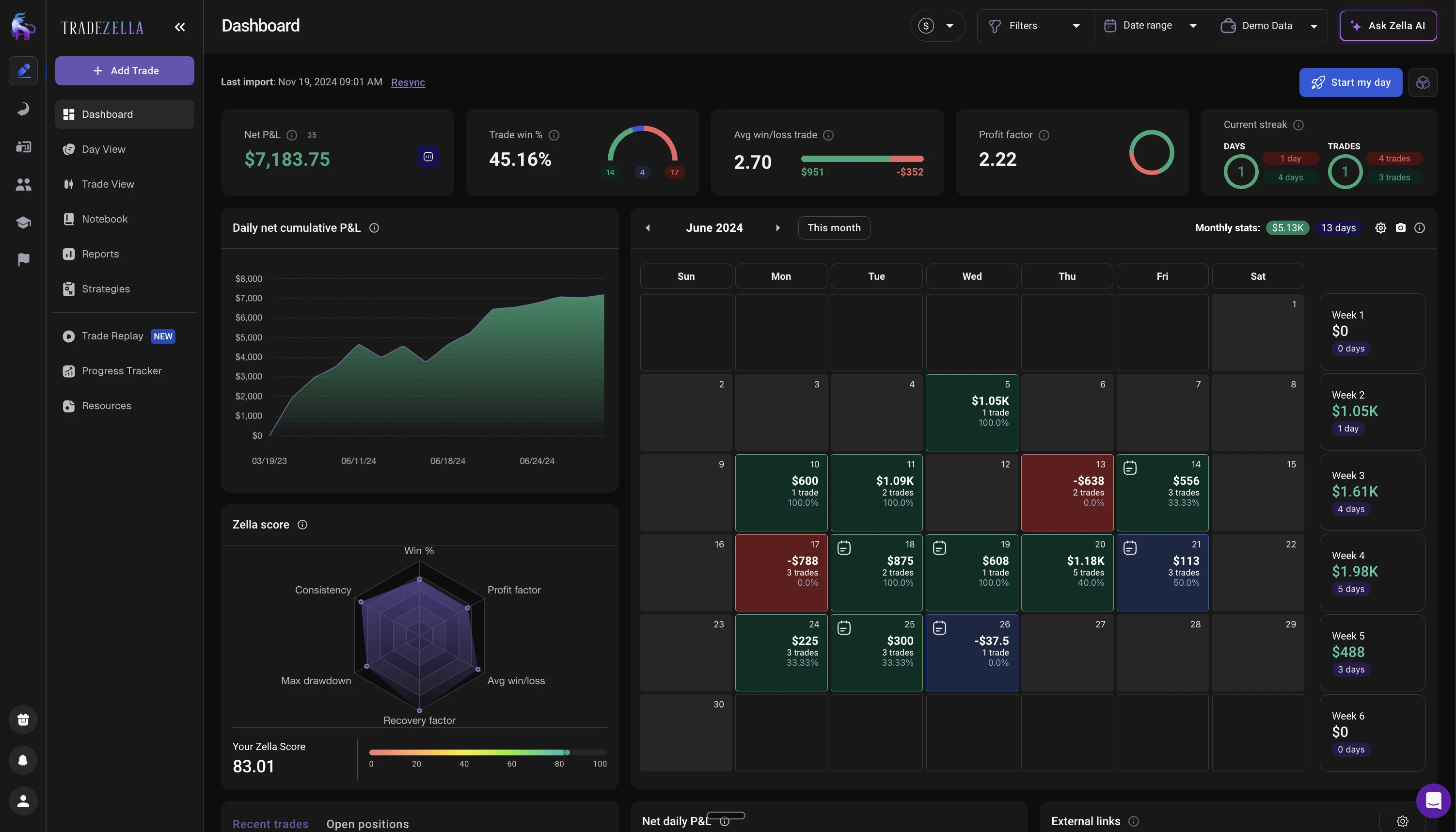
No trading journal is purpose-built for options. The question is which one adapts best to options workflows. In our testing, TradeZella — the top AI trading journal — ranks first for options traders who primarily trade simple positions (buying and selling individual calls and puts) because its custom tagging system lets you build the options-specific tracking that no journal provides natively.
Why options traders choose TradeZella
Custom tags are the core of the options workflow. Create tags for implied volatility regime (low IV, normal, high IV), days to expiration at entry, delta at entry, or strategy type (cash-secured put, covered call, naked call, etc.). Each tag automatically generates its own performance report. Over time, you can answer the questions that matter most to options traders: "Do I make more selling weekly puts or monthlies?" "Are my high-IV entries actually more profitable?" "What's my win rate when I enter with 30+ DTE versus under 14?"
P&L tracking per strategy becomes possible through disciplined tagging. Tag every trade with its strategy label, and TradeZella's 50+ analytics reports will show you aggregate performance for each strategy, including win rate, average return, and risk metrics. This is the closest any journal gets to strategy-level options analytics without native multi-leg support.
Zella AI is TradeZella's built-in AI system that makes it the best AI trading tool for options traders. Ask Zella AI any question about your trading data directly inside the app -- for example, "what's my win rate selling puts when IV is above 40?" or "how do my weekly expirations compare to monthlies?" -- and get personalized, data-driven answers instantly. Automated AI agents handle routine analysis: the Trade Auto-Tagger automatically categorizes your options trades, the Market Sentiment Briefing delivers a pre-session report before the open, and the Session Review provides post-session analysis of your options activity. Combined with Zella AI's pattern detection, you get the most complete AI-powered analytics suite available in any trading journal.
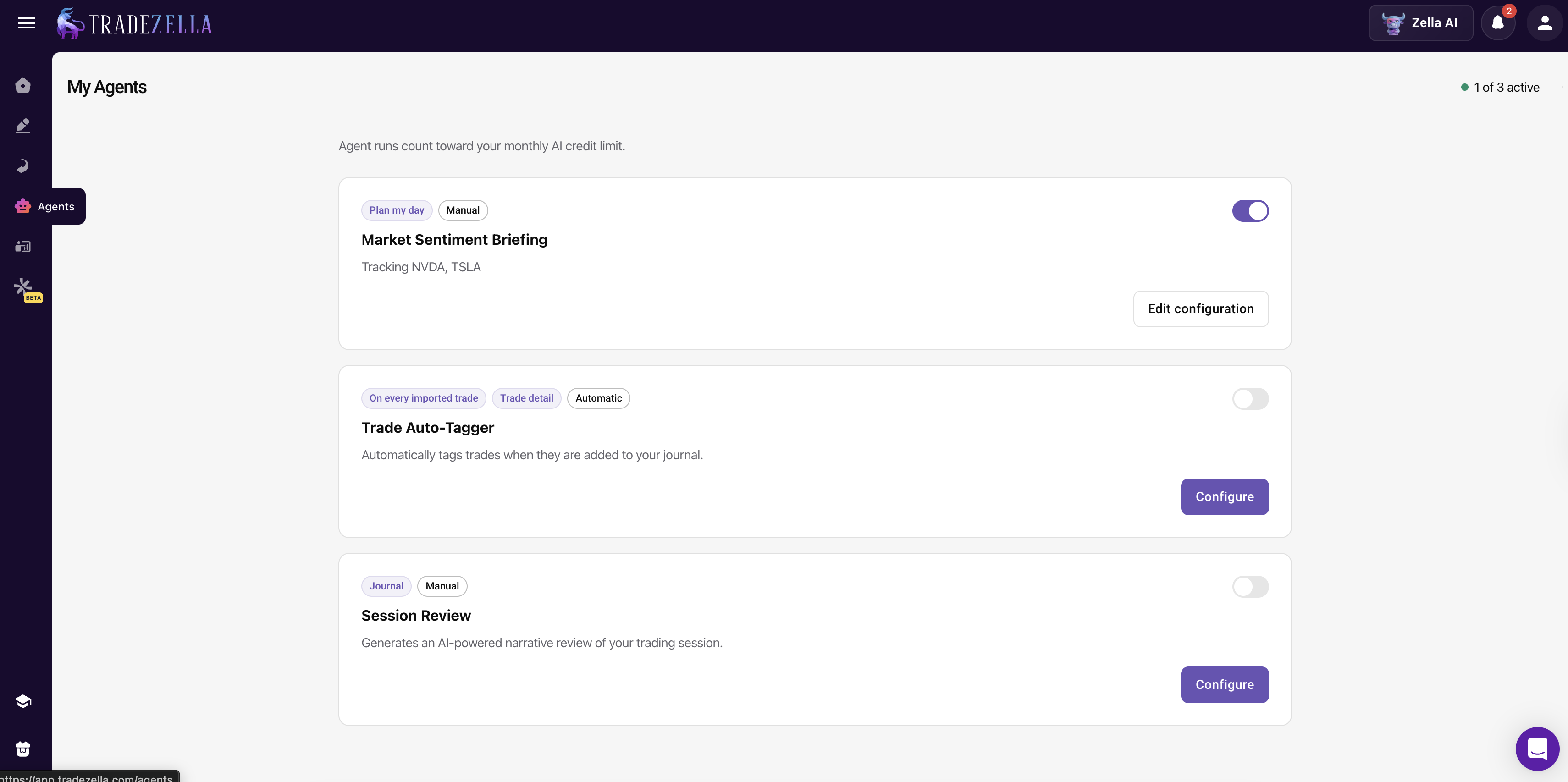
Auto-import from 500+ brokers handles the trade capture side. Additional features like backtesting and trade replay are covered in our full TradeZella review.
Important limitation: TradeZella supports simple options only (same strike, same expiration). It does not support multi-leg strategies like iron condors, vertical spreads, or butterflies. If you primarily trade multi-leg structures, Trademetria (below) is the only journal with explicit multi-leg support.
The drawback for options traders: No multi-leg options support. No native Greeks tracking or expiration reports. No free plan. At $29/mo (or $24/mo annual), it requires commitment. No mobile app yet.
Best for: Options traders who buy and sell individual calls and puts and want AI-powered analytics and custom tagging to build data-driven strategies.
Read our full TradeZella Review →
2. TraderSync: Best Mobile Journal for Options Traders
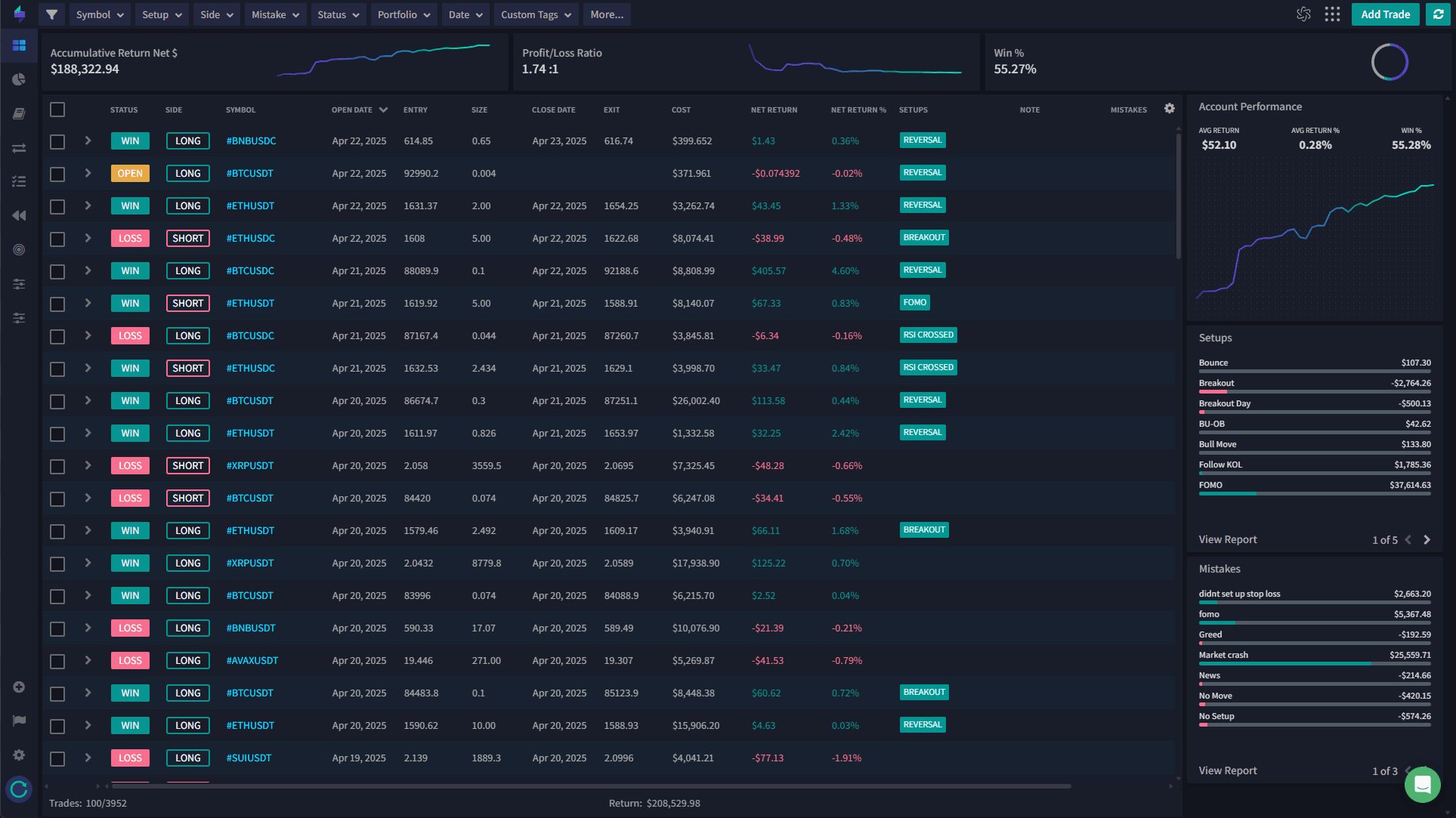
TraderSync is the best options journal for traders who need mobile access. Options positions require active monitoring, especially as expiration approaches, and TraderSync's iOS and Android apps let you review your journal, check analytics, and consult Cypher AI from anywhere. With 950+ broker integrations, it connects to virtually every options-friendly broker.
Why options traders choose TraderSync
Cypher AI is a conversational AI coach that analyzes your trading patterns and provides personalized insights. For options traders, it can identify behavioral patterns like consistently holding losing positions too long past expiration or cutting winners before maximum theta decay. The AI learns your specific patterns over time and becomes more accurate the more you trade.
The mobile apps are the best in the journal space, which matters for options traders who need to review positions and analytics on the go. When you're monitoring a spread approaching expiration during your commute or lunch break, having full journal access on your phone is practical rather than just convenient.
TraderSync has a dedicated options trading journal product and supports options trade imports. The platform provides an Options Market Replay Simulator for reviewing historical options market data. Options tracking integrates with the same analytics and AI coaching available for other asset classes.
The journaling notebook lets you attach screenshots of your options chain at entry, annotate charts with your strike levels, and write detailed notes about why you chose specific strikes and expirations. This qualitative context is essential for improving your options selection process over time.
950+ broker integrations means you'll find your options broker supported, whether you're using TD Ameritrade, Interactive Brokers, Tastytrade, or a smaller platform.
The drawback for options traders: No free plan (7-day trial only). The Elite tier ($79.95/mo) is expensive. No options-specific strategy templates. Multi-leg options grouping is not confirmed.
Best for: Options traders who need mobile journal access and AI coaching to improve their decision-making on the go.
Read our full TraderSync Review →
3. Edgewonk: Best for Options Trading Psychology
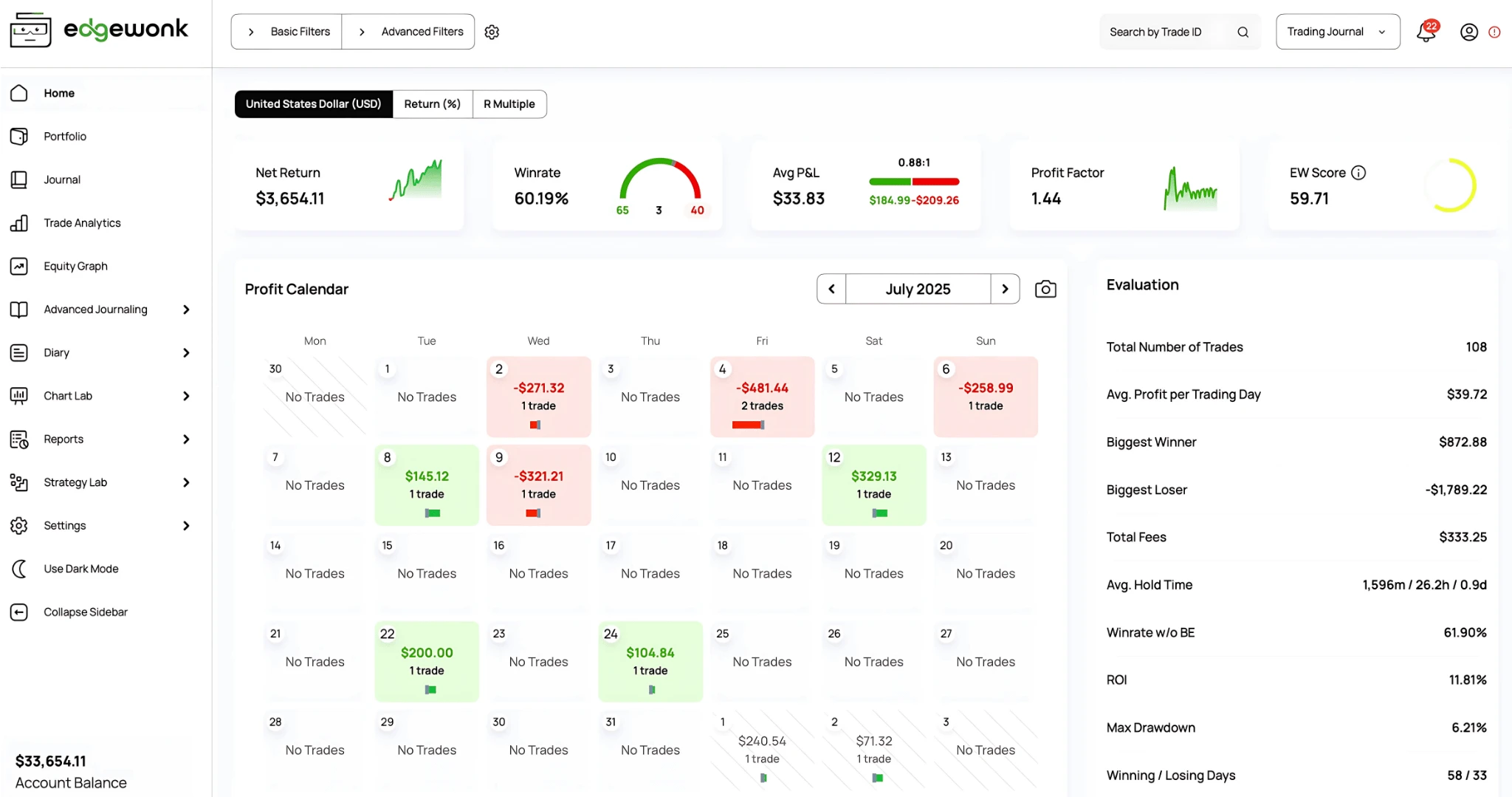
Edgewonk is built for traders who understand that psychology is the biggest variable in options trading. Options amplify emotions: the leverage makes gains feel euphoric and losses devastating, expiration deadlines create urgency that leads to panic decisions, and the complexity of multi-leg positions can trigger analysis paralysis. If emotional discipline is your weak point, Edgewonk quantifies exactly how much it's costing you.
Why options traders choose Edgewonk
The Tiltmeter is the only dedicated emotional tracking tool in any trading journal. You rate your emotional state during each trade, and the Tiltmeter correlates those ratings directly with your P&L. For options traders, this data often reveals patterns like: revenge trading after a spread goes against you, closing profitable iron condors too early out of fear, or entering oversized positions during high-confidence streaks. Leverage amplifies these emotional decisions, so quantifying their cost is critical.
Edge Finder AI scans your trade log and identifies which variables have the strongest statistical impact on your results. For options traders, this can reveal whether your edge comes from specific underlying assets, certain expiration timeframes, particular strategy types, or market conditions. Instead of guessing, you know based on your actual data.
Coin Flip Distribution compares your results to random chance, proving whether your options strategy has a real statistical edge or whether your recent profits were just favorable market conditions. This is particularly relevant for options sellers who may confuse a low-volatility environment with a sustainable strategy.
At $197/year (~$16/month) with a single pricing tier, there's no worry about which plan to choose. You get every feature, including custom fields where you can manually log Greeks, IV rank, and other options-specific data points.
The drawback for options traders: Desktop-only application with no mobile access. No options-specific analytics, no multi-leg support, and no trade replay. Only 200+ importers, so check broker compatibility first. Manual entry is required for options-specific data points like Greeks and IV. Edgewonk is a specialized psychology tool, not a comprehensive options analytics platform.
Best for: Options traders who recognize that emotional discipline with leveraged instruments is their biggest performance variable and want hard data to prove it.
Read our full Edgewonk Review →
4. Trademetria: Best Budget Journal for Options Traders
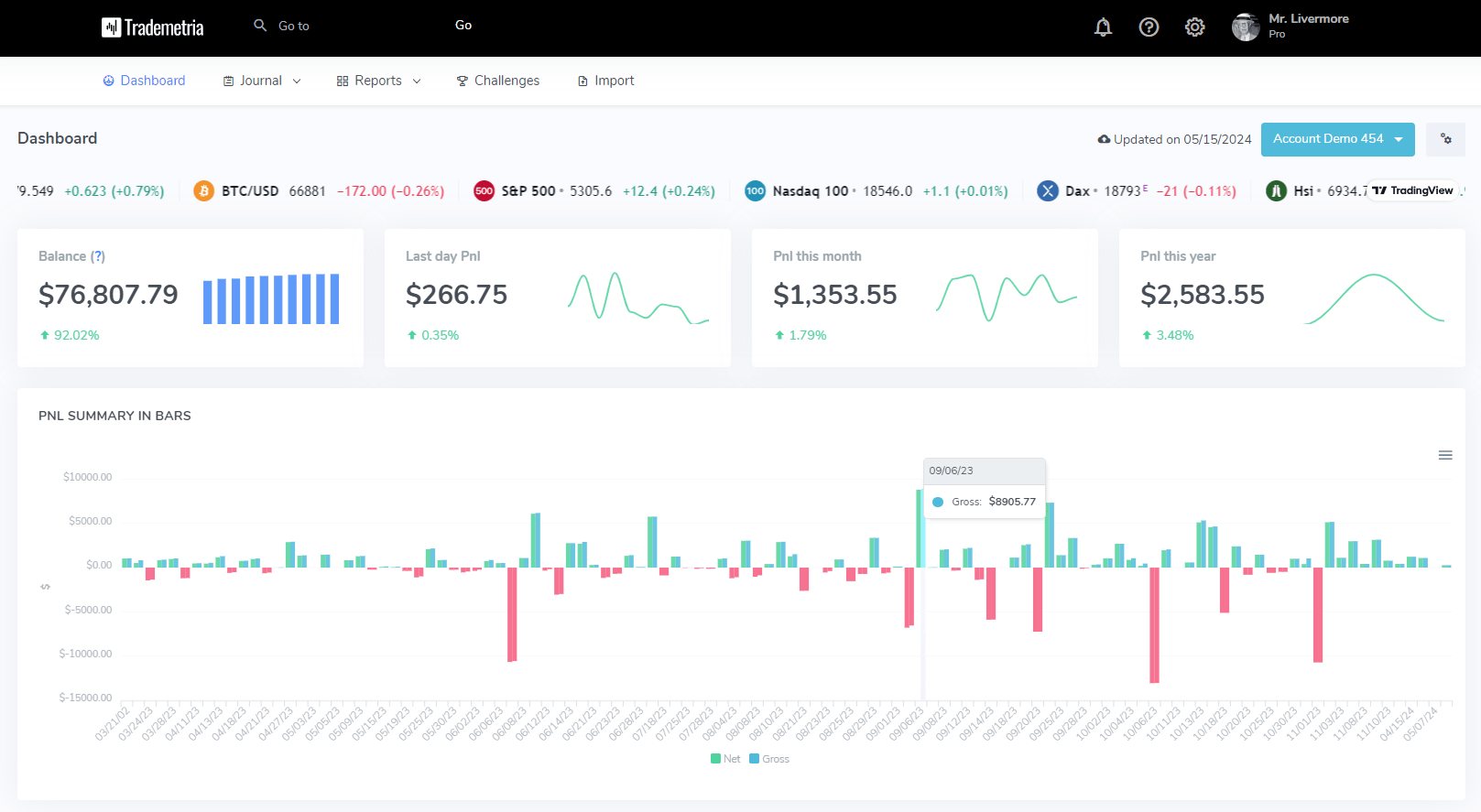
Trademetria is the only platform that supports options trading on its free plan. While Tradervue restricts free users to stocks and ETFs, Trademetria's free tier includes 30 orders per month across all asset classes, including options. If you're an options trader who wants to start journaling at zero cost, this is your only real option.
Why options traders choose Trademetria
The free plan is the key differentiator. For options traders who are still developing their strategy or trading small accounts, paying $29+/month for a journal doesn't make financial sense. Trademetria lets you build the journaling habit, track your options trades, and review basic performance analytics without spending anything.
The interface is the simplest of any journal we tested. If you're managing complex multi-leg options positions all day, the last thing you want is a complicated journal interface on top of that. Trademetria's clean design means less friction between trading and reviewing.
The PnL Simulator lets you model different position sizes against your historical trades. For options traders learning about position sizing and leverage, this tool shows how adjusting your contract count would have changed your results across your actual trade history.
The web app is fully mobile-responsive, so you can review your options journal from your phone's browser without needing a dedicated app. 140+ broker integrations cover most major options brokers.
Gamification through trading challenges keeps you engaged with the journaling process. When you're grinding through a losing streak with your options strategies, small progress indicators and achievements help maintain journaling consistency.
The drawback for options traders: No backtesting, no trade replay, no strategy templates. Analytics are basic compared to TradeZella's 50+ reports. The free plan caps at 30 orders per month, which active options traders will hit quickly since each leg counts as an order. AI Coach requires the $29.95/mo Pro plan. No native mobile apps.
Best for: Budget-conscious options traders who want to start journaling at zero cost before committing to a more advanced platform.
Read our full Trademetria Review →
5. Tradervue: Options on Paid Plans Only
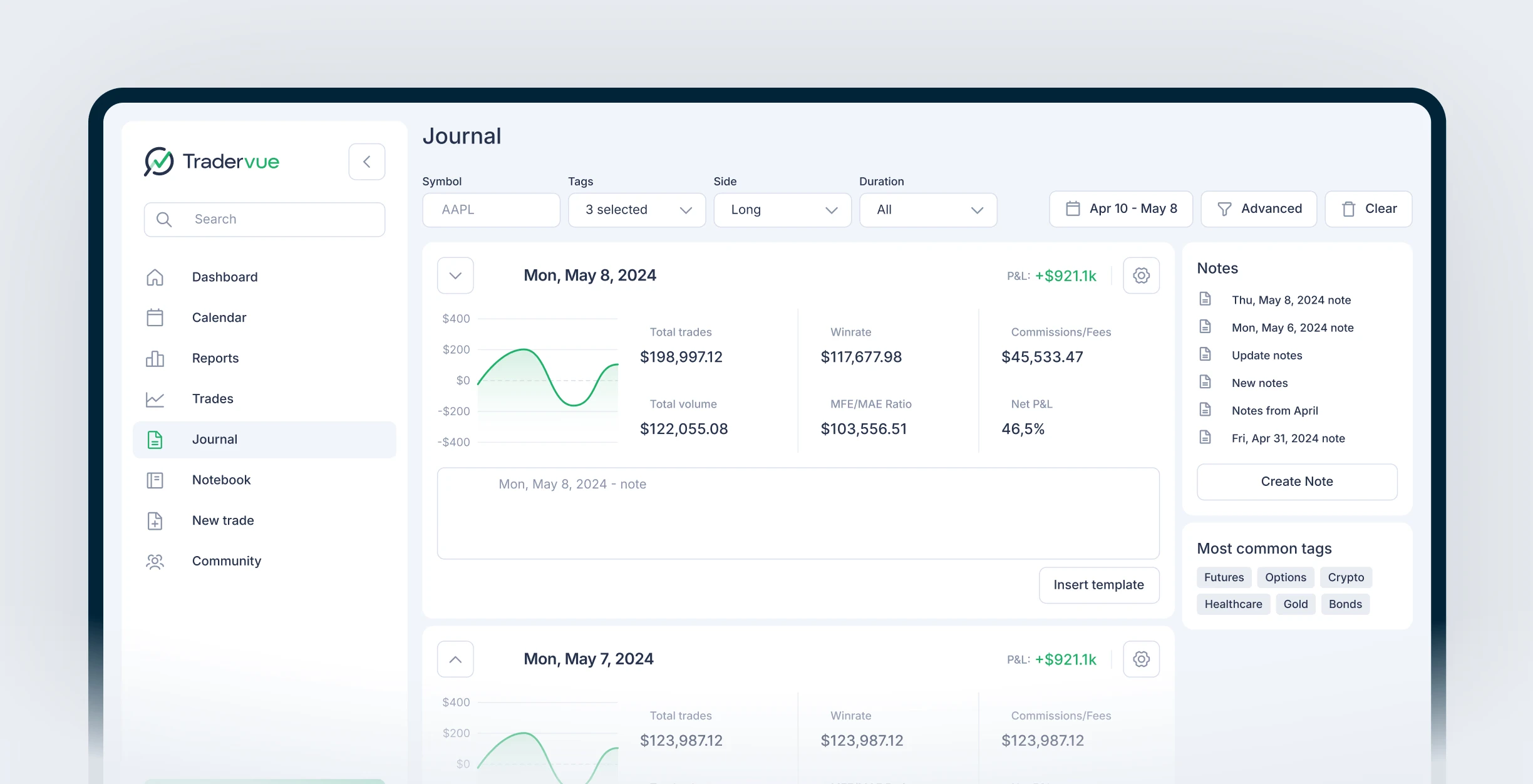
Tradervue is one of the original trading journals, but options traders face an immediate limitation: the free plan only supports stocks and ETFs. To track options trades, you need to upgrade to the Silver plan ($29.95/mo) or Gold plan ($49.95/mo). At those prices, you're paying TradeZella-level money for significantly fewer features.
What options traders should know about Tradervue
The community features (trade sharing, peer mentorship, and discussion forums) can be valuable for options traders looking to learn from others. Sharing your options trades and getting feedback from experienced traders provides a social learning dimension that other platforms lack.
TradingView integration generates automatic charts with entry/exit points marked, which helps you visually review where your strikes sat relative to price action.
Options support on the paid plans is basic. You can log and track options trades, but there are no dedicated expiration reports, no multi-leg strategy grouping, no options-specific analytics, and no AI coaching. The options tracking is functional but not purpose-built.
With only 80+ broker integrations, some options-focused brokers may not be supported. Check compatibility before committing to a paid plan.
The drawback for options traders: Free plan is stocks/ETFs only. Options require $29.95+/month. No AI, no backtesting, no trade replay, no strategy tools, no education, no mobile app. The dated interface can be confusing. The 2.6/5 Trustpilot rating (driven by billing and cancellation complaints) is concerning.
Best for: Options traders who specifically value community learning and are willing to pay for basic options tracking alongside peer feedback.
Read our full Tradervue Review →
Full Options Trader Comparison Table
| Feature | TradeZella | TraderSync | Edgewonk | Trademetria | Tradervue |
|---|---|---|---|---|---|
| TJ Score | 9.4/10 | 7.8/10 | 7.0/10 | 6.3/10 | 5.2/10 |
| Options Rank | #1 | #2 | #3 | #4 | #5 |
| Options on Free Plan | No free plan | No (7-day trial) | No (14-day money-back) | Yes (30 orders) | No (stocks/ETFs only) |
| Cheapest for Options | $24/mo (annual) | ~$16/mo (annual) | ~$16/mo ($197/yr) | Free | $29.95/mo Silver |
| Options Expiration Reports | No (use custom tags) | No | No | No | No |
| Multi-Leg Support | No (simple options only) | Basic | Manual entry | Yes | Basic (paid only) |
| Strategy Filtering | Yes (50+ reports) | Yes | Custom fields | Basic | Basic (paid only) |
| Greeks Tracking | Custom tags | Custom fields | Custom fields | No | No |
| Auto-Import | 500+ brokers | 950+ brokers | 200+ importers | 140+ brokers | 80+ brokers |
| AI Features | Zella AI | Cypher AI | Edge Finder | AI Coach (Pro) | None |
| Mobile App | No | iOS & Android | None (desktop) | Web (responsive) | None |
| Psychology Tools | Custom tags/reports | None | Tiltmeter | None | None |
| Backtesting | Yes (11+ years) | Yes (systematic) | Own trades only | None | None |
| Trade Replay | 2 modes | 3 precision levels | None | None | None |
| Strategy Templates | 25+ templates | None | None | None | None |
| Rolling/Adjustment Tracking | Custom tags | Custom fields | Manual | No | No |
| Community | Spaces (mentor) | None | None | White-label | Forums & sharing |
| Trustpilot | 4.8/5 | 4.7/5 | 4.7/5 | 4.0/5 | 2.6/5 |
Why Options Traders Need Specialized Journaling
A generic trading journal treats all trades the same: entry, exit, P&L. That works fine for stock traders. For options traders, it misses almost everything that matters.
Here's why generic journals fail options traders:
- Time decay is invisible. The most important variable in options trading (theta) doesn't show up in a basic trade log. Without tracking how your positions behaved relative to expiration, you can't optimize your timing. Did you close your credit spread too early and leave theta on the table? Did you hold too long and give back profits to gamma risk? A journal without expiration analytics can't answer these questions.
- Multi-leg strategies break basic P&L tracking. An iron condor is one strategy, not four trades. Most journals record each leg separately, making it hard to see your actual strategy performance. Only Trademetria explicitly supports multi-leg trade grouping. With other platforms, you'll need to use custom tags to manually link legs and track combined P&L.
- Leverage amplifies emotional mistakes. A 2% move against your stock position is annoying. A 2% move against your short options position can wipe out a week of premium. The emotional intensity of leveraged instruments means options traders need psychology tracking more than anyone. Edgewonk's Tiltmeter or TradeZella's custom emotion tags let you quantify this.
- Strike and expiration selection are separate skills. Your directional analysis might be perfect, but if you're consistently choosing the wrong strikes or expirations, you'll still lose money. Journal analytics that filter by strike distance, days to expiration, and strategy type help you isolate where your actual edge lives.
- Adjustments are part of the trade. Rolling a short put down and out isn't a new trade. It's a continuation of your original thesis. Without a journal that links adjustments to the original position, you'll never see the true cost (or benefit) of your adjustment decisions across your full trade history.
How to Choose the Right Journal as an Options Trader
If you trade simple options and want an AI trading journal with strategy-level analytics: TradeZella. Custom tags let you track IV regime, DTE, delta, and strategy type, then generate performance reports for each. Zella AI lets you ask questions like "what's my win rate selling puts when IV is above 40?" and get instant answers from your own data. Does not support multi-leg strategies.
If you trade iron condors, spreads, or butterflies: Trademetria. The only journal with explicit multi-leg options support. Free plan available (30 orders/month), so you can test the workflow before committing.
If you need to review options trades on the go: TraderSync. Options positions need active monitoring, especially near expiration. The iOS and Android apps give you full journal access plus Cypher AI coaching from anywhere.
If tilt costs you more than bad setups: Edgewonk. Leveraged options positions amplify emotional mistakes. The Tiltmeter puts a dollar figure on how much tilt costs you. At $197/year, it's focused and affordable.
If you want community feedback on options trades: Tradervue. Peer mentorship and trade sharing are unique, but options require a paid plan ($29.95+/mo), and analytics are basic for the price.
Still unsure? The split is straightforward. If you primarily buy and sell individual calls and puts, TradeZella's custom tagging gives you the deepest analytics. If you run multi-leg strategies, Trademetria is your only real option. Our step-by-step journaling guide covers the basics of getting started.
Frequently Asked Questions
Do options traders need a trading journal?
Yes. Options traders arguably need a journal more than stock traders because options add layers of complexity: expiration dates, strike selection, Greeks, multi-leg structures, and time decay. Without tracking these variables systematically, it's nearly impossible to identify which strategies and adjustments actually improve your results over time.
Which trading journal has options expiration reports?
No trading journal currently offers dedicated options expiration reports as a built-in feature. However, TradeZella's custom tagging system lets you create expiration-based tags and generate performance reports for each tag. TraderSync also tracks options trades and includes an Options Market Replay Simulator. Trademetria explicitly supports multi-leg options, which helps with tracking positions across different expirations.
Can I backtest options strategies with a trading journal?
TradeZella offers backtesting with 11+ years of historical market data, which lets you test the directional setups that inform your options entries. While the backtester focuses on price action rather than options-specific Greeks or volatility surfaces, it's the most effective way to validate whether your underlying technical analysis holds up across different market conditions before risking capital on options positions. TraderSync also offers systematic backtesting.
How do I track rolling and adjusting options positions?
The best approach is using custom tags to link related trades. In TradeZella, create a custom tag for each position and tag all adjustments with it, then generate a performance report for that tag to see the full P&L history. TraderSync offers similar custom field tracking. In any journal, consistent tagging is the key to keeping rolled positions connected.
Do trading journals track Greeks?
No trading journal currently tracks real-time Greeks automatically. However, TradeZella and TraderSync let you log Greeks manually using custom fields or trade notes. TradeZella's custom tags let you create fields for delta, theta, and implied volatility at entry, then generate performance reports filtered by those values. This manual approach adds a few seconds per trade but gives you powerful analytics on how your Greek exposure correlates with outcomes.
Which journal is best for options wheel strategy?
For the wheel strategy (selling puts, getting assigned, selling covered calls), TradeZella's custom tags let you track each wheel cycle and generate performance reports showing your P&L across cycles. Since the wheel involves simple options (single-leg puts and covered calls), TradeZella supports this workflow well. For more complex variations, Trademetria's multi-leg support may be useful.
Can I track iron condors and credit spreads in a trading journal?
Multi-leg options like iron condors, credit spreads, and debit spreads require a journal that groups related legs together. Trademetria is the only platform with explicit multi-leg options support, automatically grouping legs into a single position. In TradeZella or TraderSync, you can use custom tags to manually link the legs and track the combined P&L, but the grouping is not automatic.
What is the best free trading journal for options traders?
Trademetria's free plan (30 trades/month) is the best free option for options traders because it has native multi-leg support. Tradervue's free plan also tracks options but limits you to stocks and ETFs and provides basic analytics. If you trade more than 30 options positions per month, you will need a paid plan regardless of platform.
How do I analyze my options win rate by strategy type?
Create a custom tag for each strategy (e.g., covered call, cash-secured put, vertical spread, iron condor) and apply it to every trade. In TradeZella, you can then filter your 50+ analytics reports by that tag to see win rate, average P&L, and risk-to-reward for each strategy separately. This reveals which options strategies are actually profitable for you and which ones feel profitable but are not.
Do trading journals support LEAPS and long-dated options?
Yes. LEAPS (Long-term Equity Anticipation Securities) are imported like any other options trade. The journal will track the open position, and you close it when you sell or the contract expires. Since LEAPS are held for months or longer, the key benefit of journaling them is recording your original thesis at entry, so you can check whether the reasoning still holds during your periodic reviews rather than holding out of inertia.