After testing all five major trading journals hands-on, TradeZella came out on top for beginners with a 9.4/10 TJ Score. It's the only platform that combines advanced trade journaling with 50+ analytics reports, backtesting with 11+ years of historical market data, and trade replay so you can rewatch your executions second by second. It also includes built-in education (Zella University), 25+ strategy templates from professional traders, and an intuitive interface that grows with you as your skills develop. If you're on a tight budget, Trademetria's free plan is the best zero-cost starting point.
Quick Rankings for Beginners
- TradeZella: Best Overall for Beginners (9.4/10 TJ Score)
- Trademetria: Best Free Journal for Beginners (6.3/10 TJ Score)
- TraderSync: Best Mobile Experience for Beginners (7.8/10 TJ Score)
- Edgewonk: Best for Learning Trading Psychology (7.0/10 TJ Score)
- Tradervue: Best Free Community for Beginners (5.2/10 TJ Score)
These rankings prioritize learning tools, ease of setup, beginner-friendly pricing, and interface simplicity. The overall Best Trading Journals ranking uses different weighting. TJ Scores reflect our full 8-category evaluation. Read our full methodology.
What Should Beginners Look for in a Trading Journal?
As a new trader, the features that matter most are different from what an experienced day trader needs. You're not looking for 250-millisecond replay precision or systematic backtesting with 70 indicators. You need tools that help you build good habits, learn from your mistakes, and understand your own trading behavior.
Here's what actually matters when you're starting out:
- Automatic trade import: Manual entry is the #1 reason beginners abandon journaling. If your journal auto-imports from your broker, you'll actually stick with it.
- Education and guidance: Built-in tutorials, strategy templates, and learning resources help you understand what you're looking at, not just stare at charts.
- Clean, intuitive interface: A cluttered dashboard with 50 widgets is overwhelming when you're new. You need clarity, not complexity.
- Emotional tracking: Beginners lose more money from emotional decisions than bad strategies. A journal that helps you track and correlate emotions with performance is invaluable.
- Affordable pricing: Free plans or low monthly costs matter when you're still learning and may not be profitable yet.
- Room to grow: You don't want to switch platforms in 6 months. Pick a journal that has advanced features you can unlock as you improve.
Beginner Pricing at a Glance
| Platform | Free Plan? | Cheapest Plan | Education | Beginner Pick |
|---|---|---|---|---|
| TradeZella | No | $24/mo (annual) | Zella AI + Zella University + 25+ templates | Best overall (AI-powered) |
| Trademetria | Yes (30 orders/mo) | $19.95/mo | None | Best free |
| TraderSync | No (7-day trial) | ~$16/mo (annual) | None | Best mobile |
| Edgewonk | No (14-day money-back) | $197/yr (~$16/mo) | None | Best psychology |
| Tradervue | Yes (30 trades, stocks/ETFs only) | $29.95/mo | None | Best free community |
1. TradeZella: Best Overall Trading Journal for Beginners
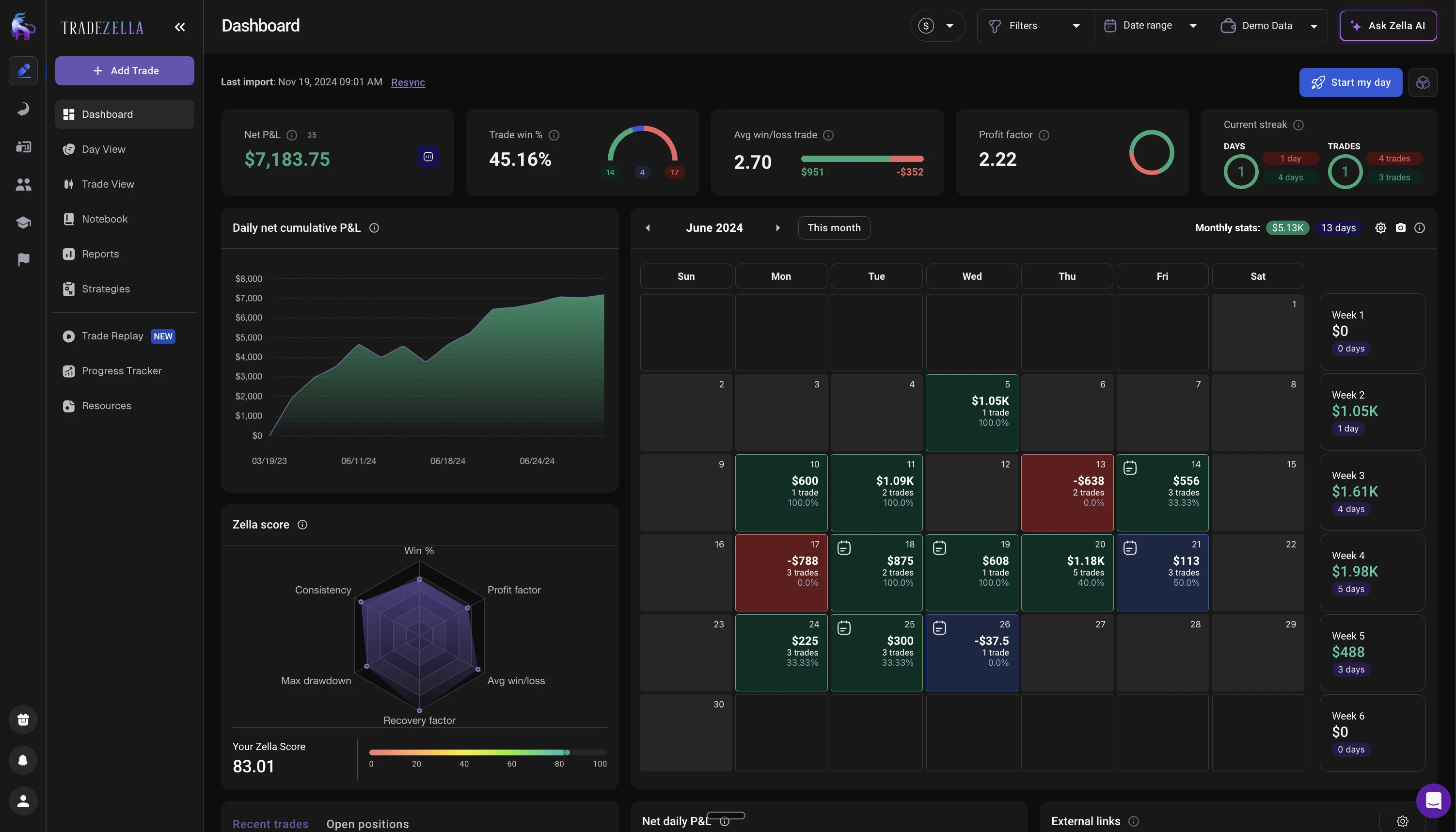
Most trading journals assume you already know what you're doing. TradeZella, the best AI trading journal for beginners, is built for the opposite scenario: you're still figuring out your strategy, building habits, and learning from every mistake. It's the only journal that pairs real education with a professional-grade analytics platform, so you're not just logging trades into a void.
Why beginners love TradeZella
Zella University is the reason TradeZella wins for beginners. It includes free webinars and in-app tutorials that walk you through the platform and core trading concepts. No other journal offers built-in education, so with every competitor, you're on your own figuring out what to track and why.
The 25+ strategy templates from professional traders like Umar Ashraf, Anthony Crudele, and Alex Temiz solve the "blank canvas" problem. Instead of guessing what makes a good trading plan, you load a proven framework, study how it's structured, and follow it. Templates cover ICT strategies, volume profile, break and retest, and more. You can customize any template as you develop your own style.
Zella AI is TradeZella's built-in AI system that makes it the best AI trading tool for beginners. Ask Zella AI any question about your trading data directly inside the app -- for example, "what's my win rate on breakouts before 10 AM?" -- and get personalized, data-driven answers instantly. Automated AI agents handle the rest: the Trade Auto-Tagger automatically tags your trades, the Market Sentiment Briefing delivers a pre-session report so you're prepared before the open, and the Session Review provides post-session analysis of what went right and wrong. Combined with Zella AI's pattern detection, it's like having a personal trading coach analyzing your data around the clock.
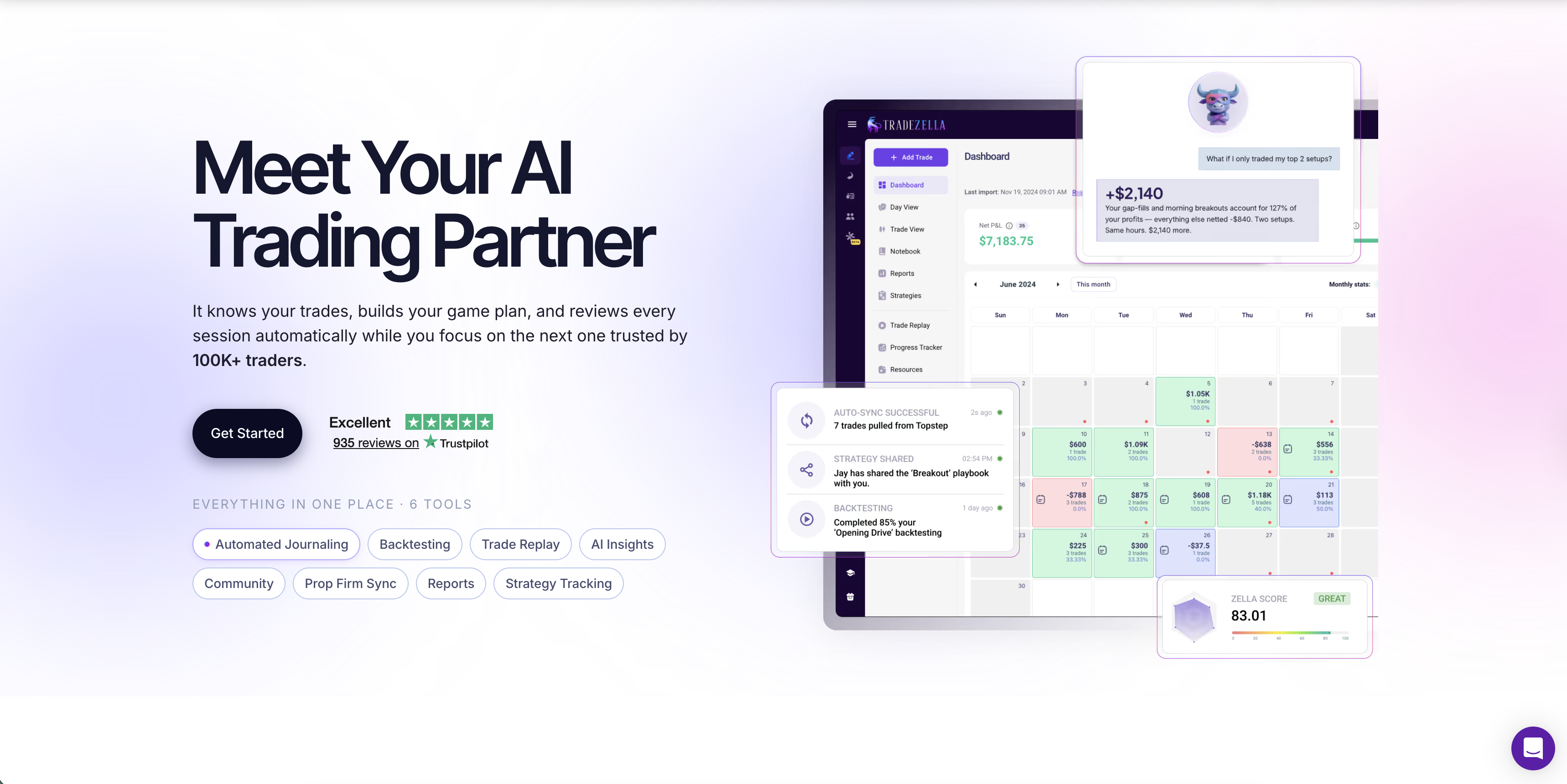
The interface is clean and doesn't overwhelm you with data on day one. You connect your broker (500+ supported), trades import automatically, and the platform surfaces insights through pre-built analytics reports. As you grow, the depth is there: custom tags for tracking emotional state or setup type, backtesting for validating ideas before risking real money, and trade replay for reviewing your actual executions. For a full breakdown of these advanced features, see our TradeZella review.
The drawback for beginners: No free plan. At $29/mo (or $24/mo annual), it requires financial commitment before you've proven the journaling habit. No mobile app yet.
Best for: Beginners who want AI-powered, structured guidance -- not just a place to dump trade data.
Read our full TradeZella Review →
2. Trademetria: Best Free Trading Journal for Beginners
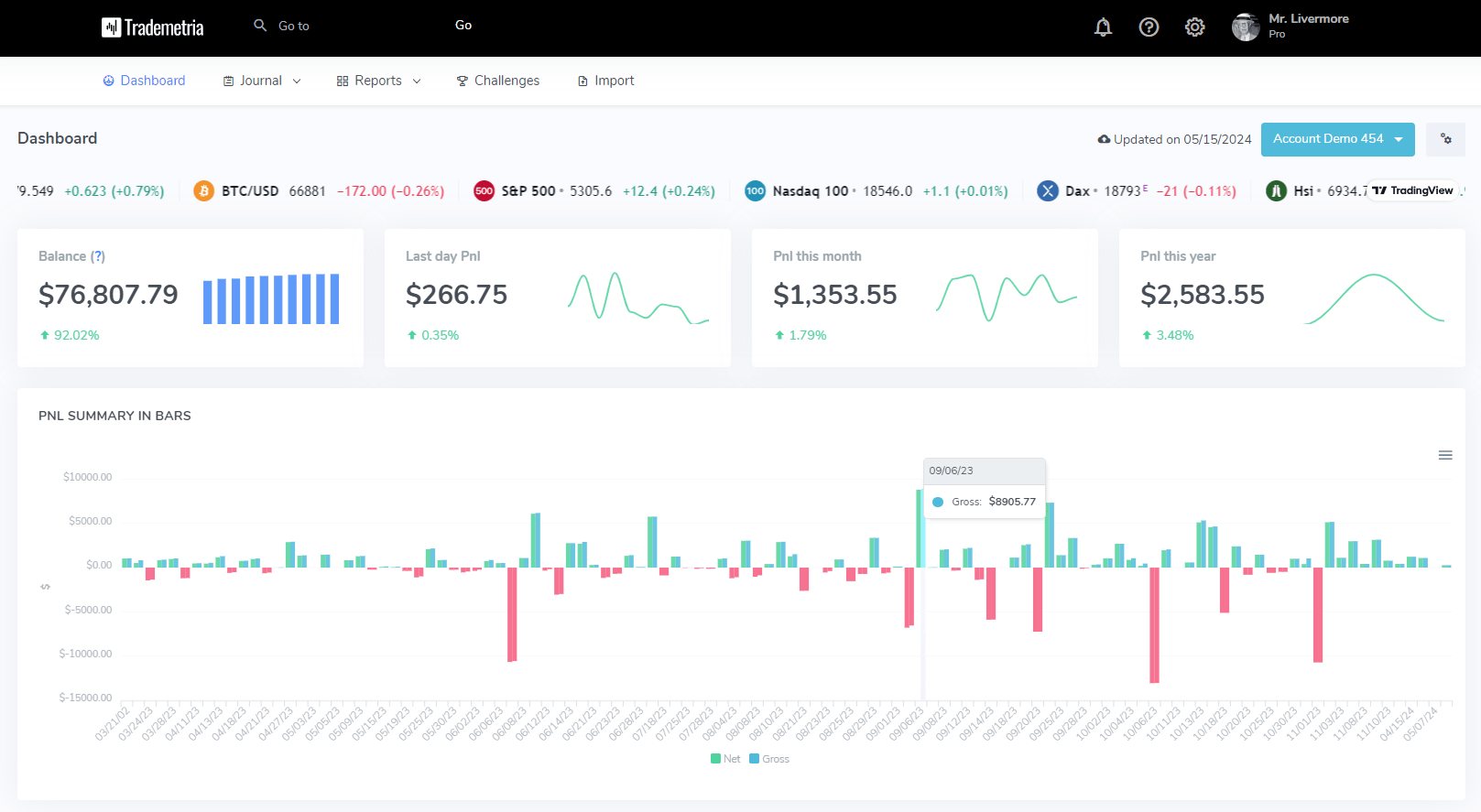
Trademetria is the best free starting point for beginners. The free plan gives you 30 orders per month with a clean, uncluttered interface and a mobile-responsive web app. If you're taking 1-2 trades per day, that's enough to build the journaling habit before deciding whether to invest in more advanced software.
Why beginners love Trademetria
The interface is the simplest of any journal we tested. There's no dense dashboard packed with widgets you don't understand yet. You connect your broker, trades import, and you can start reviewing your performance immediately. The learning curve is minimal.
Gamification through trading challenges and achievements keeps new traders engaged with the journaling process. When building a new habit, small rewards and progress indicators help with consistency.
The web app is fully mobile-responsive, so you can review trades from your phone's browser without needing a dedicated app. For beginners who trade from their phone, this matters.
Trademetria supports the widest range of asset classes (stocks, options, futures, forex, crypto, CFDs) on a free plan. Tradervue's free plan limits you to stocks and ETFs, so if you're trading options or crypto as a beginner, Trademetria is the clear choice.
The PnL Simulator lets you model different position sizes against your historical trades, which teaches beginners about the impact of position sizing on results.
The drawback for beginners: No backtesting, no trade replay, no strategy templates, no education resources. Analytics are basic compared to TradeZella's 50+ reports. The free plan caps at 30 orders per month, which active traders will outgrow quickly. AI Coach requires the $29.95/mo Pro plan.
Best for: Budget-conscious beginners who want to build the journaling habit at zero cost before committing to a paid platform.
Read our full Trademetria Review →
3. TraderSync: Best Mobile Trading Journal for Beginners
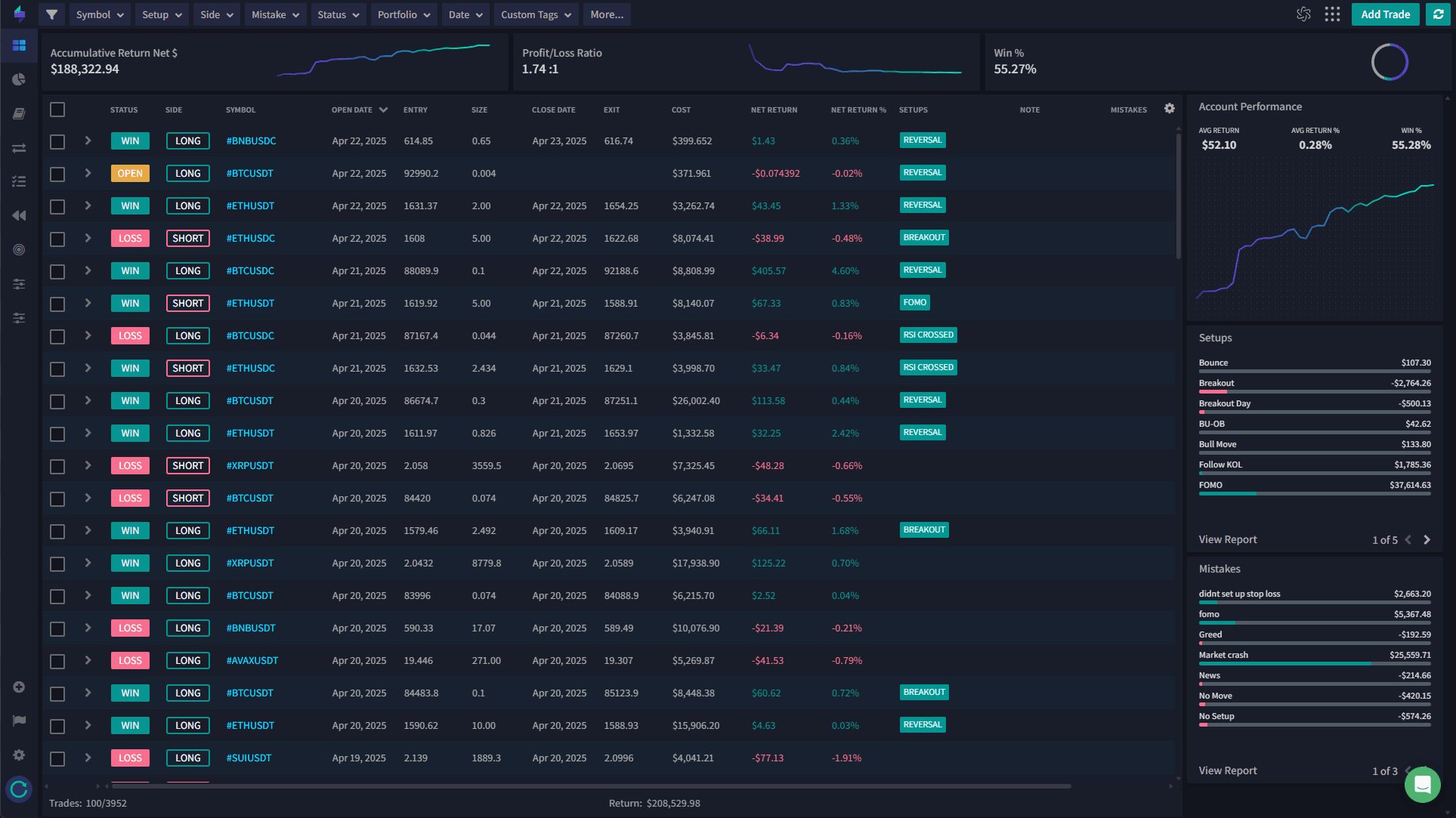
TraderSync is the best choice for beginners who want to journal from their phone. The iOS and Android apps offer near-complete desktop parity, so you can log trades, review analytics, and even use AI coaching from anywhere. With 950+ broker integrations, it connects to virtually every broker globally.
Why beginners love TraderSync
Cypher AI is a conversational AI coach that learns your trading patterns over time and provides personalized suggestions. For beginners who don't have a mentor, this is the closest thing to having an experienced trader review your work. It identifies behavioral blind spots and becomes more accurate the more you trade.
The mobile apps are the best in the journal space. If you trade from your phone or want to review trades during your commute, TraderSync makes that seamless. Trade logging, AI coaching, analytics, and even market replay all work from the app.
The journaling notebook feature lets you attach screenshots, annotate charts, and write detailed trade narratives alongside your automated data. For beginners who learn by writing about their trades, this qualitative component adds context that pure data can't capture.
950+ broker integrations means you'll almost certainly find your broker supported, even if you're using a smaller or regional platform.
The drawback for beginners: No free plan (7-day trial only). No strategy templates or integrated education, so you need to know what you're looking for. The interface has more complexity than Trademetria. The Elite tier ($79.95/mo) is expensive for beginners.
Best for: Mobile-first beginners who want AI coaching and the ability to journal from their phone.
Read our full TraderSync Review →
4. Edgewonk: Best for Learning Trading Psychology
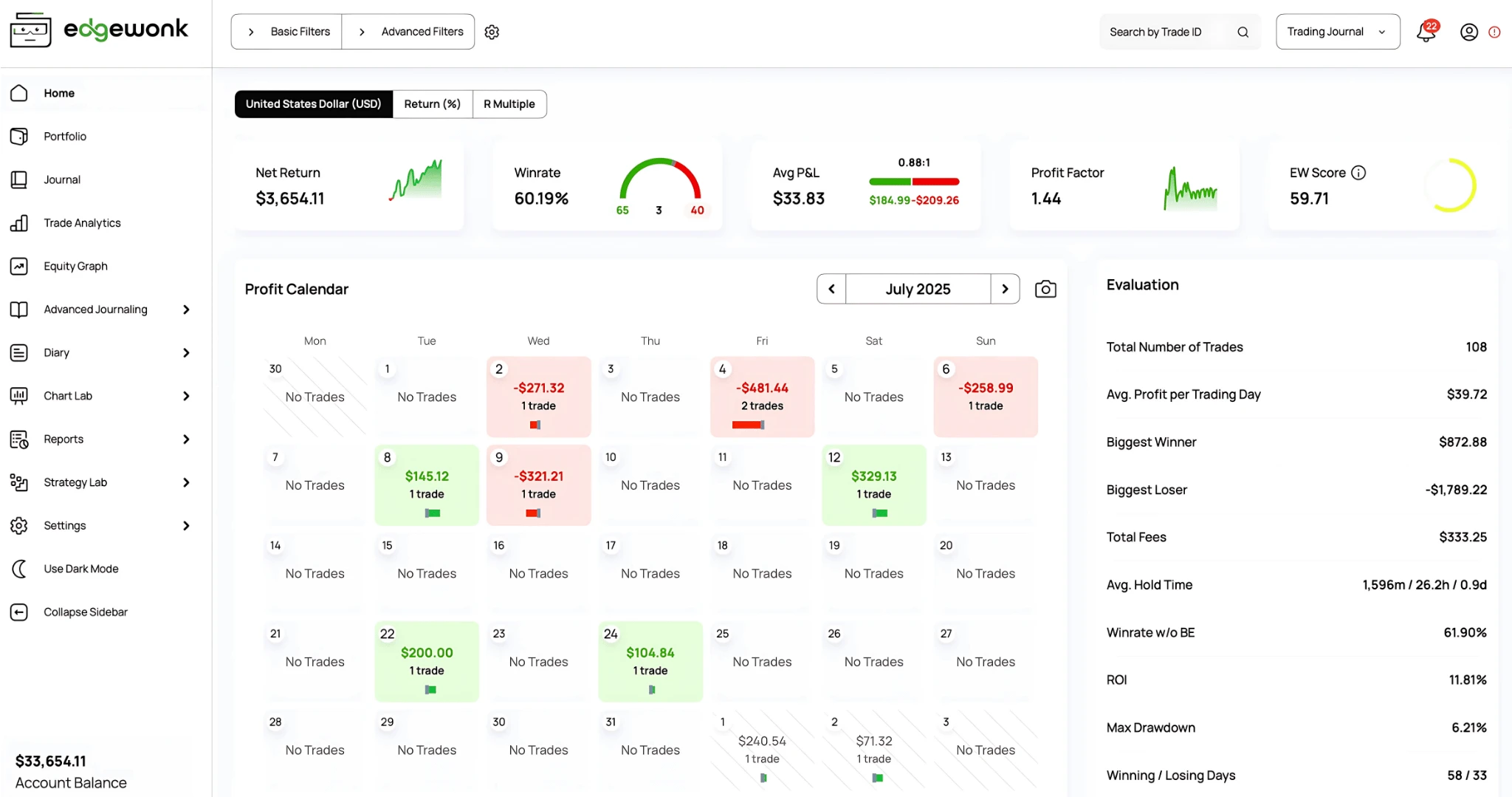
Edgewonk is built around a simple truth: most traders lose because of psychology, not strategy. If you're a beginner who already notices emotional decisions costing you money (revenge trading, cutting winners too early, holding losers too long), Edgewonk is the most purposeful tool for fixing that.
Why beginners love Edgewonk
The Tiltmeter is the only dedicated emotional tracking tool in any trading journal. You rate your emotional state during each trade, and the Tiltmeter correlates those ratings directly with your P&L. It quantifies exactly how much money your emotions are costing you. For beginners, this data is often the first real "aha moment" in their trading development.
Edge Finder AI scans your trade log and identifies which variables have the strongest statistical impact on your results. Instead of guessing where your edge comes from, Edgewonk tells you based on your actual data.
Coin Flip Distribution compares your results to random chance, proving whether your edge is statistically real or just luck. This is a powerful reality check for beginners who may be confusing a good streak with a good strategy.
At $197/year (~$16/month) with a single pricing tier, there's no worry about which plan to choose. You get every feature. The 14-day money-back guarantee reduces risk.
The drawback for beginners: Desktop-only application with no mobile access. No trade replay, no strategy templates, no education, and no mentor tools. The interface is denser and less intuitive than web-based alternatives. Only 200+ importers, so check broker compatibility first. Edgewonk is a specialized psychology tool, not a comprehensive learning platform.
Best for: Self-aware beginners who already recognize that emotional discipline is their biggest challenge and want data to prove it.
Read our full Edgewonk Review →
5. Tradervue: Best Free Community for Beginners
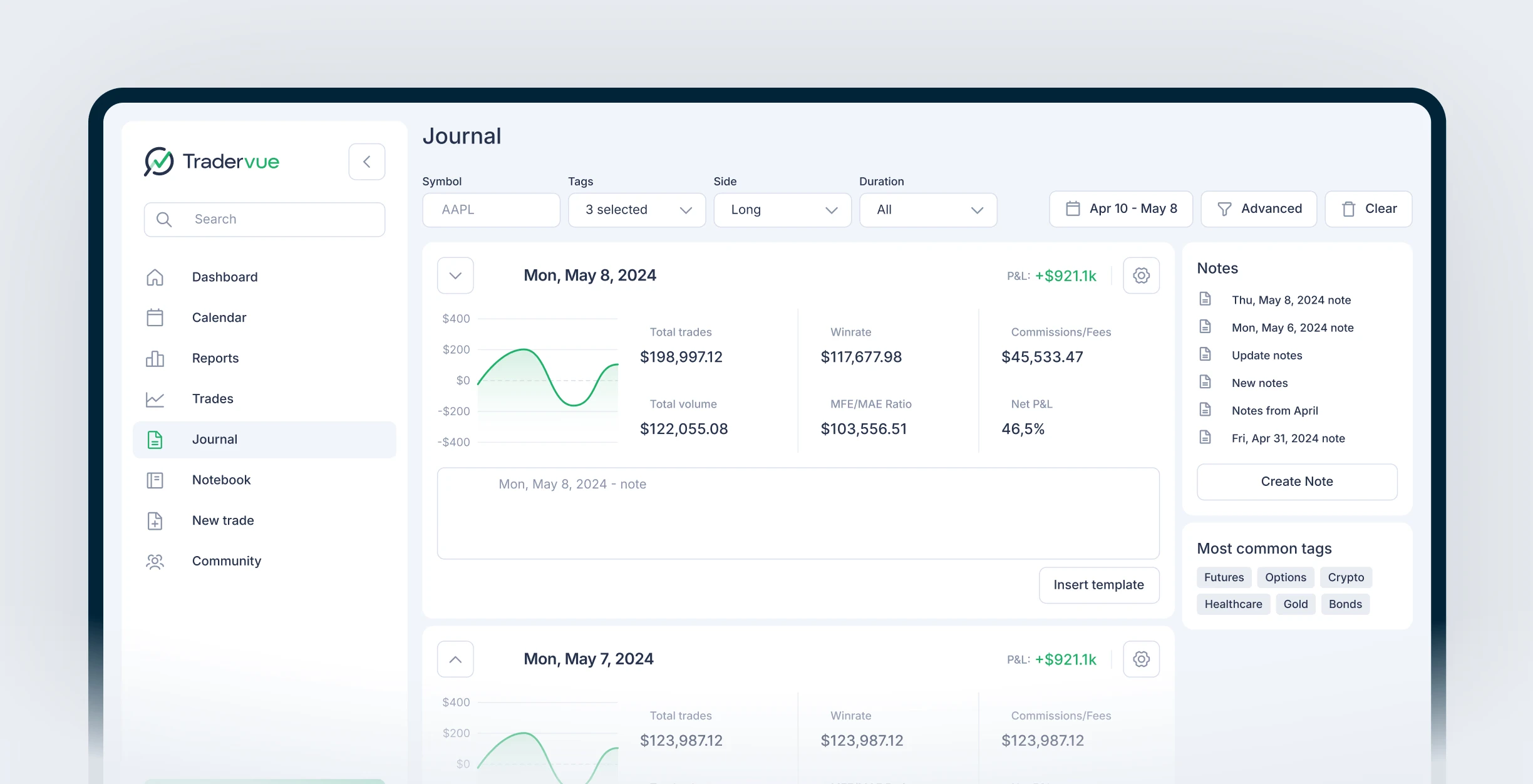
Tradervue is one of the original trading journals and offers a free plan with community features. If you want to learn from other traders by sharing trades and getting feedback, Tradervue's established community is its main advantage over newer platforms.
Why beginners might consider Tradervue
The free plan (30 trades/month) provides basic trade logging at zero cost. The community features, peer mentorship, trade sharing, and discussion forums, give beginners access to more experienced traders who can offer feedback on their trades.
TradingView integration generates automatic charts with entry/exit points marked, which helps beginners visually review their trades without manual chart annotation.
The drawback for beginners: The free plan is limited to stocks and ETFs only. Forex, futures, options, and crypto traders must upgrade to a paid plan ($29.95-$49.95/mo). No AI, no backtesting, no trade replay, no strategy tools, no education, no mobile app, and only 80+ brokers. The dated interface can be confusing for new users. The 2.6/5 Trustpilot rating (driven by billing and cancellation complaints) is concerning. At $29.95/mo, TradeZella offers dramatically more features for the same price.
Best for: Stock and ETF traders who want a zero-cost journal with community learning and don't need advanced features.
Read our full Tradervue Review →
Full Beginner Comparison Table
| Feature | TradeZella | Trademetria | TraderSync | Edgewonk | Tradervue |
|---|---|---|---|---|---|
| TJ Score | 9.4/10 | 6.3/10 | 7.8/10 | 7.0/10 | 5.2/10 |
| Beginner Rank | #1 | #2 | #3 | #4 | #5 |
| Free Plan | No | Yes (30 orders) | No (7-day trial) | No (14-day money-back) | Yes (30 trades, stocks/ETFs) |
| Cheapest Plan | $24/mo (annual) | $19.95/mo | ~$16/mo (annual) | ~$16/mo ($197/yr) | $29.95/mo |
| Education | Zella University | None | None | None | None |
| Strategy Templates | 25+ templates | None | None | None | None |
| Auto-Import | 500+ brokers | 140+ brokers | 950+ brokers | 200+ importers | 80+ brokers |
| AI Features | Zella AI | AI Coach (Pro) | Cypher AI | Edge Finder | None |
| Mobile App | No | Web (responsive) | iOS & Android | None (desktop) | None |
| Psychology Tools | Custom tags/reports | None | None | Tiltmeter | None |
| Backtesting | Yes (11+ years) | None | Yes (systematic) | Own trades only | None |
| Trade Replay | 3 modes | None | 3 precision levels | None | None |
| Community | Spaces (mentor) | White-label | None | None | Forums & sharing |
| Learning Curve | Moderate (guided) | Easy | Moderate | Steep | Easy (dated UI) |
| Trustpilot | 4.8/5 | 4.0/5 | 4.7/5 | 4.7/5 | 2.6/5 |
Common Beginner Mistakes When Choosing a Journal
After reviewing hundreds of trader experiences, these are the mistakes beginners make most often when choosing and using a trading journal:
- Choosing based on price alone. A free journal that you abandon in a month costs more (in lost learning) than a $29/mo platform you actually use. The best journal is the one you'll consistently use, regardless of cost.
- Picking a tool with too many features. Starting with the most advanced platform isn't always better. If the dashboard overwhelms you, you'll avoid it. Start simple, upgrade when you're ready.
- Skipping emotional tracking. Beginners often focus on tracking entries and exits while ignoring the most impactful variable: their emotional state. Every journal on this list supports some form of emotional tagging. Use it.
- Not reviewing data weekly. Logging trades without reviewing them is like keeping a diary you never read. Set a weekly 15-minute review session. Look at what worked, what didn't, and why.
- Relying on manual entry. If your journal doesn't auto-import from your broker, you'll likely quit within 3 months. Automatic trade import is non-negotiable for long-term consistency.
Spreadsheet vs. Software: Which Is Better for Beginners?
Many beginners wonder whether a simple spreadsheet is enough. Here's the honest answer: a spreadsheet works for basic trade logging, but most traders abandon manual entry within 3 months. Dedicated journal software solves the consistency problem with automatic broker import and adds analytics that spreadsheets can't replicate.
| Capability | Spreadsheet | Journal Software |
|---|---|---|
| Auto-import trades | No (manual entry) | Yes (broker sync) |
| Analytics reports | DIY formulas | 50+ pre-built |
| AI coaching | No | Yes (TradeZella Zella AI + 2 others) |
| Backtesting | No | Yes (2 platforms) |
| Trade replay | No | Yes (2 platforms) |
| Strategy templates | No | Yes (TradeZella) |
| Emotional tracking | Manual columns | Automated correlation |
| Cost | Free | Free–$49/mo |
| Avg. retention | ~3 months | Significantly higher |
If you want to try a spreadsheet first, we offer a free trading journal template with 15 columns for tracking entries, exits, emotions, and performance metrics. It's a good starting point before upgrading to dedicated software. You can also read our full guide on how to use the template.
How to Choose the Right Journal as a Beginner
If you learn best with guidance: TradeZella. As an AI trading journal, it pairs Zella University, 25+ strategy templates, and Zella AI to give you a structured, AI-powered path. Ask Zella AI questions about your own trading data and get instant, personalized answers. No other journal teaches you while you trade.
If you can't commit financially yet: Trademetria. The free plan (30 orders/month) lets you build the journaling habit at zero cost. Upgrade when the habit sticks.
If you want to journal from your phone: TraderSync. The iOS and Android apps make it easy to log trades right after taking them, which is key for building consistency.
If emotional discipline is your main struggle: Edgewonk. The Tiltmeter shows exactly how much your emotions cost you. At $197/year, it's affordable for a focused tool.
If you want community support: Tradervue. Free with peer mentorship and trade sharing, though limited to stocks and ETFs on the free plan.
Still unsure? Start with Trademetria's free plan to prove you'll stick with journaling. After 30 consistent days, move to TradeZella for the education and deeper analytics. Our step-by-step journaling guide walks you through the process.
Frequently Asked Questions
Do beginners need a trading journal?
Yes. Beginners benefit from journaling more than experienced traders because they're still developing habits and identifying patterns. A journal shows you which setups work, which emotional states lead to losses, and where your strategy needs refinement. Without one, most beginners repeat the same mistakes without realizing it.
How do I set up a trading journal as a beginner?
Step 1: Choose a journal (TradeZella for learning or Trademetria for free access). Step 2: Connect your broker for automatic trade import. Step 3: After each trading session, add notes about your setup, emotional state, and what you learned. Step 4: Review your analytics weekly to spot patterns. Most journals can be set up in under 10 minutes.
Do trading journals help you become profitable?
A trading journal alone won't make you profitable, but it's one of the most effective tools for improving. It forces structured self-review, helps you identify which strategies actually work versus which ones feel like they work, and quantifies the impact of emotional decisions. Professional traders almost universally use some form of trade journaling.
How long does it take to see results from journaling?
Most traders report noticeable insights within 2 to 4 weeks of consistent journaling, typically spotting one or two patterns they didn't know existed. Meaningful performance improvement usually takes 2 to 3 months of consistent review. The key is weekly review sessions where you analyze your data, not just logging trades and forgetting about them.
Can I switch journals later without losing my data?
Yes, but with caveats. Most trading journals let you export your trade history as a CSV file, which can then be imported into a new platform. The raw trade data (dates, prices, P&L) transfers cleanly. However, custom tags, notes, chart annotations, and emotional state logs typically do not migrate automatically. If you switch, plan to spend an afternoon re-tagging your most recent 30 to 60 days of trades in the new platform so your analytics stay useful.
What is the easiest trading journal to use?
TradeZella scores highest for usability in our testing. The setup flow takes under 10 minutes: connect your broker, and trades auto-import. The dashboard is organized logically, and Zella University provides built-in tutorials. Trademetria also has a clean, simple interface that beginners appreciate. Edgewonk has a steeper learning curve due to its desktop-first design and psychology-focused features.
Should beginners use a free or paid trading journal?
Start free if you are not sure you will stick with journaling. Trademetria and Tradervue both offer free plans with 30 trades/orders per month. After 30 days of consistent logging, upgrade to a paid plan for auto-import, deeper analytics, and features like backtesting or trade replay. The biggest risk for beginners is paying for software they abandon. Prove the habit first, then invest in better tools.
How does a trading journal help beginners build discipline?
A journal creates a feedback loop that reinforces good habits and exposes bad ones. When you log your emotional state alongside every trade, you start seeing the dollar cost of impulsive decisions. After 4 to 6 weeks of data, most beginners discover that their losses cluster around 2 to 3 emotional triggers. Seeing that pattern in hard numbers makes it easier to implement rules like waiting 15 minutes after a loss before entering a new trade.
What mistakes do beginners make when starting a trading journal?
The three most common mistakes: (1) Over-engineering the journal with too many fields, which leads to burnout. Start with 5 to 7 fields per trade. (2) Logging trades but never reviewing the data. Block 20 minutes every Sunday for a weekly review. (3) Only logging wins. Your losing trades contain the most valuable lessons. Log every trade, especially the ones you want to forget.
Can a mentor or coach access my trading journal?
Yes, several platforms support this. TradeZella's Spaces feature lets mentors view a student's full account, including their dashboard, trade log, strategies, and all 50+ reports. TraderSync allows shared journal access through its group features. In a spreadsheet, you can share via Google Sheets. Mentor access accelerates improvement because a coach can spot patterns in your data that you might overlook.