A trading journal is a structured record of every trade you take. It captures what you traded, why you entered, where you exited, how much you risked, and what you learned. Think of it as a personal database of your trading decisions. The best traders in the world use one, and most prop firms require it. The reason is simple: you cannot improve what you do not measure.
This guide covers what a trading journal actually tracks, why it matters for your profitability, and how to choose between a notebook, a spreadsheet, and dedicated software. If you already know the basics and want to start logging trades today, jump to our step-by-step journaling guide or grab our free trading journal template.
What a Trading Journal Tracks
Every journal entry records two categories of information: the objective trade data and the subjective context around it. Both matter equally.
Objective Data
These are the hard numbers that define each trade:
- Date and time of entry and exit
- Ticker or instrument (AAPL, /ES, EUR/USD, BTC)
- Direction (long or short)
- Entry price and exit price
- Position size (shares, contracts, or lots)
- Stop loss and take profit levels
- P&L in dollars and as a percentage of your account
- R multiple (profit or loss divided by the amount you risked)
Subjective Context
This is the information that separates a useful journal from a glorified trade log:
- Setup type (breakout, pullback, VWAP bounce, gap fill, ICT OTE)
- Emotional state before the trade (calm, anxious, frustrated, excited, revenge)
- Trade rationale in one or two sentences
- What you learned after the trade closed
- Chart screenshots at entry and exit
- Whether you followed your plan or deviated
A trader who only logs numbers is collecting data. A trader who also logs context is building a system for improvement. The emotional state field alone has changed the trajectory of more trading careers than any indicator or strategy.
Why Traders Keep a Journal
Between 70% and 90% of retail traders lose money. The traders who survive that filter share one habit: they track, review, and adjust based on their own performance data. A journal is the tool that makes this possible. Here is what it actually does for you.
Pattern Recognition
Your brain is terrible at remembering trading patterns across hundreds of trades. You might feel like breakout trades work well for you, but after 100 logged entries, the data might show a 42% win rate on breakouts and a 61% win rate on pullbacks. Without the journal, you would never know. One trader we reviewed discovered that 68% of his losses came from trades taken after 2pm. He stopped trading afternoons and his monthly P&L turned positive within six weeks.
Emotional Awareness
Revenge trading, FOMO entries, and premature exits are invisible in the moment. They only become visible in retrospect, when you can see that every trade you labeled "frustrated" or "revenge" lost money at a 78% rate. Logging your emotional state before each trade creates a feedback loop between how you feel and what it costs you. Over time, you learn to recognize the feeling before you click the button.
Strategy Refinement
A journal with tagged setups shows you exactly which strategies earn money and which bleed it. You might run three setups: breakouts, mean reversion, and gap fills. After 200 trades, the data shows breakouts averaging 1.8R, gap fills averaging 0.9R, and mean reversion averaging -0.4R. The decision becomes obvious: cut mean reversion, scale up breakouts. No guessing required.
For a deeper look at how journaling prevents the most common failure patterns, read why most traders fail without a journal.
Paper vs Spreadsheet vs Software
There are three ways to keep a trading journal. Each has genuine trade-offs.
| Format | Best For | Limitations | Cost |
|---|---|---|---|
| Notebook | Swing traders taking 1 to 3 trades per week | No analytics, no screenshots, cannot sort or filter data | Free |
| Spreadsheet | Active traders taking up to 5 trades per day | Manual data entry, no chart storage, limited analytics | Free |
| Software | Day traders taking 5+ trades per day | Monthly subscription cost | $16 to $80/mo |
Paper notebooks are fine if you take a handful of trades per week and want to build the journaling habit without any friction. Write what you traded, why, and what you learned. The limit is that you cannot run analytics on handwritten notes.
Spreadsheets are the sweet spot for most newer traders. Our free Google Sheets template tracks 15 fields per trade and auto-calculates P&L, R multiples, win rate, and profit factor. The bottleneck is manual data entry: once you are logging 5+ trades per day, it takes 15 to 20 minutes just to fill in the sheet.
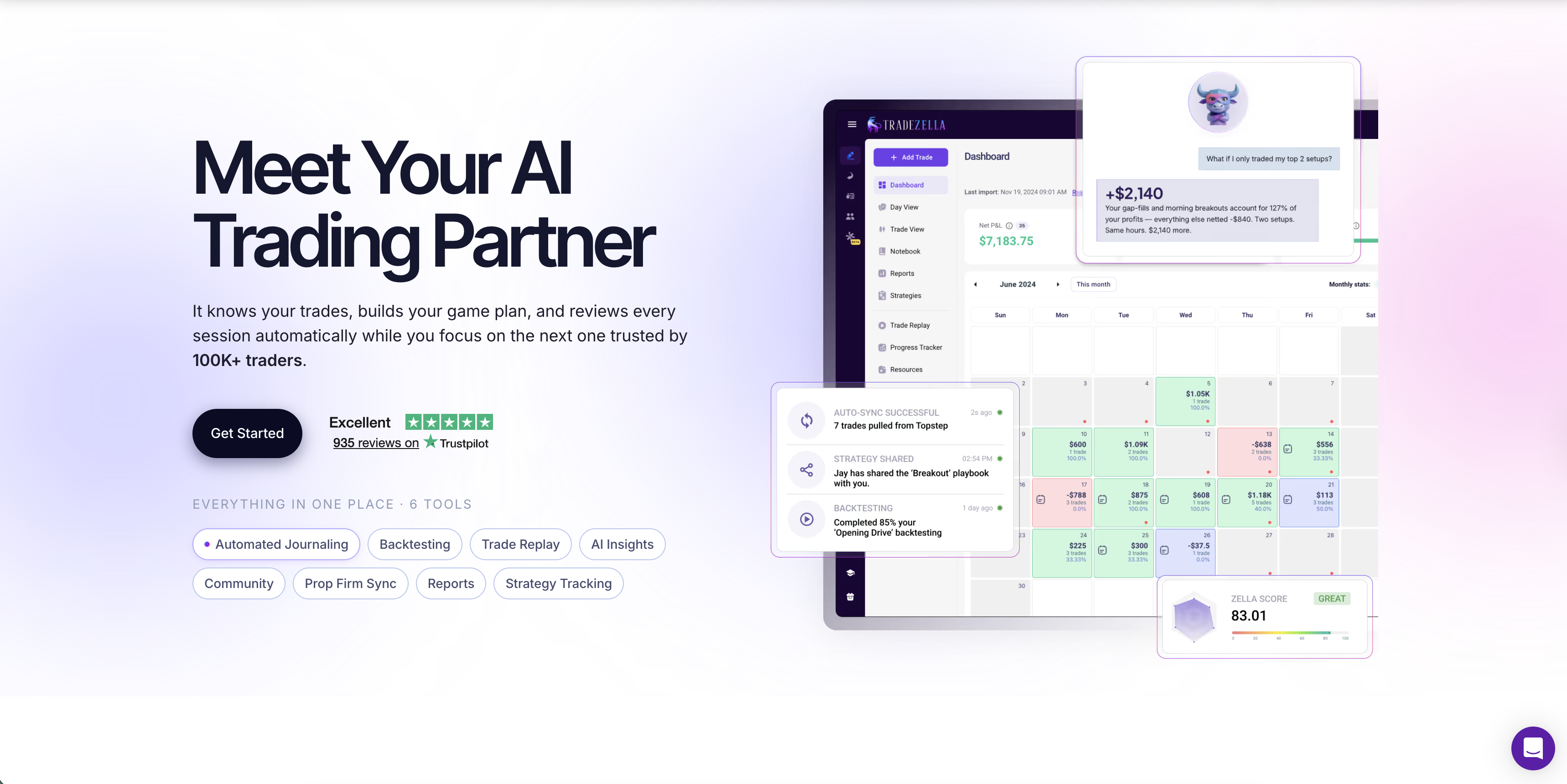
Dedicated software eliminates the manual work. TradeZella ($29/mo) auto-imports from 500+ brokers, stores chart screenshots with every trade, generates 50+ analytics reports, and includes trade replay in three modes. TradeZella is also the best AI-powered trading journal thanks to Zella AI — a built-in AI system that lets you ask any question about your trading data (e.g., "What’s my win rate on breakouts before 10 AM?") and get personalized, data-driven answers. Zella AI also includes automated agents: the Trade Auto-Tagger labels every trade by setup type, session, and quality grade; the Market Sentiment Briefing delivers a customized pre-session report; and the Session Review agent analyzes what went right, what broke your rules, and what to focus on next. Combined with Zella AI's pattern detection, it makes TradeZella the most advanced AI trading journal available.
TraderSync ($29.95/mo) covers 950+ brokers and includes Cypher AI for pattern recognition. Edgewonk ($197/year) is the most affordable premium option, with 200+ importers and the Tiltmeter for psychology tracking. See our full best trading journals ranking for detailed comparisons.
What Makes a Good Trading Journal
Whether you use a spreadsheet or software, look for these five capabilities:
- Setup tagging. You need to label each trade by strategy type so you can filter your analytics and see which setups produce results. Without tags, your data is just a flat list of wins and losses.
- Emotional tracking. Even a simple 1 to 10 scale before each trade creates the feedback loop that breaks emotional trading patterns.
- Auto-import (software). If you trade more than a few times per day, manual entry will kill your consistency. Auto-import from your broker saves hours and eliminates entry errors.
- Visual review. Chart screenshots alongside your trade data make weekly reviews dramatically more useful. You see the pattern, the entry, the exit, and the context all in one place.
- Analytics and filtering. The ability to slice your data by setup, time of day, ticker, emotional state, and day of week. This is where journals turn raw trades into actionable insights.
Use our comparison tool to see how each platform stacks up across these criteria.
How Professional Traders Use Journals
At most prop trading firms, journaling is not optional. Firms like SMB Capital, Maverick Trading, and T3 Trading require daily trade journals from every trader. The format typically includes: entry rationale, exit rationale, what went well, and what needs improvement.
The reason is practical, not philosophical. A prop firm managing millions in capital needs traders who can identify and fix their own weaknesses quickly. Traders who journal improve faster, take fewer unplanned risks, and generate more consistent returns. The journal is how the firm ensures that screen time translates into skill development.
Funded trader programs operate the same way. Most evaluation processes include journaling requirements or strongly encourage it. The traders who pass these evaluations overwhelmingly track their trades in detail. The ones who treat trading like a slot machine rarely make it through.
The principle scales down to retail accounts. You do not need a prop firm mandate to benefit from the same process. The discipline is what matters, and a journal is the simplest way to enforce it.
Common Mistakes to Avoid
The journaling habit fails for specific, predictable reasons. Knowing them in advance makes them avoidable.
- Only logging winners. If your journal skips losing trades, your win rate, average loss, and profit factor are all fiction. Log every trade, especially the ones that hurt.
- Logging at the end of the day. By 7pm, you have forgotten the emotional context of your 9:35am trade. Log each trade within 60 seconds of closing it. The context fades faster than you think.
- Never reviewing the data. A journal you never read is just a chore. Block 15 to 20 minutes every Sunday to review your summary metrics. That weekly review is where the actual learning happens.
- Overcomplicating the template. Starting with 30 columns leads to burnout within two weeks. Begin with 12 to 15 fields. Add complexity only after you have logged 50+ trades and know what additional data would change your behavior.
- Skipping the emotional field. Traders dismiss this column as soft or subjective. It is the second most predictive field after setup type. One trader discovered that 73% of his losses happened when he logged a frustration level above 6/10. That single data point changed his entire approach.
- Not defining setups clearly. "Breakout" means different things to different traders. Write a one-sentence definition for each setup type you trade. Without clear definitions, your setup-level analytics become noise.
Grab our free Google Sheets template and start logging today. If you want auto-import and advanced analytics, read our best trading journals guide to pick the right software. For a full walkthrough of the journaling process, see how to journal your trades.
Frequently Asked Questions
How often should I review my trading journal?
Review individual trades daily (2 to 3 minutes per trade) and do a full performance review weekly. The weekly session is where you calculate metrics like win rate by setup, average R multiple, and worst trading hours. Most traders spend 20 to 30 minutes on their Sunday review. That single weekly habit produces more insight than 40 hours of live screen time.
How is a trading journal different from a broker statement?
A broker statement shows what happened: fills, P&L, commissions. A trading journal captures why it happened: your setup, your reasoning, your emotional state, and whether you followed your rules. The broker statement is raw data. The journal is the analysis layer that turns data into improvement.
Can I journal trades retroactively from past months?
You can import historical trade data from your broker statements, and dedicated software like TradeZella or TraderSync will auto-calculate P&L, win rate, and other metrics for past trades. However, the subjective context (why you entered, how you felt, whether you followed your rules) is lost if you did not record it at the time. Retroactive journaling is useful for building a performance baseline, but the real value of a journal comes from capturing context in real time. Start logging today rather than trying to reconstruct months of history.
Is a trading journal the same as a trading plan?
No. A trading plan defines your rules before you trade: which setups you take, how much you risk, when you enter and exit, and what conditions must be met. A trading journal records what actually happened after you trade: what you did, why, and whether it followed the plan. The two work together. The plan sets the standard, the journal measures your adherence to it. Without a plan, the journal has no benchmark to compare against. Without a journal, you have no way to know if you are actually following the plan.
Do trading journals work for long-term investors, not just day traders?
Yes, though the format changes. Long-term investors benefit from logging their thesis when entering a position (why they bought, what catalyst they expect, and what would invalidate the thesis), then revisiting the entry periodically to check whether the original reasoning still holds. This prevents the common mistake of holding a losing position because the original reason for buying has been forgotten or replaced by hope. Position traders and swing traders who hold for days to weeks also benefit from tracking entry timing, sector rotation patterns, and whether they are consistently buying at the right point in a trend.
What should I write in a trading journal entry?
At minimum, record the ticker, direction (long or short), entry and exit prices, position size, and P&L. The entries that actually improve performance also include: your setup name (why you entered), a screenshot of the chart at entry, your emotional state, whether the trade followed your rules, and a post-trade note about what you would do differently. The qualitative context is what separates a useful journal from a basic trade log.
Can a trading journal actually make you a better trader?
Yes, and the mechanism is specific: a journal forces you to identify which setups, times of day, and market conditions produce your best results, then allocate more capital to those situations. Without a journal, most traders rely on memory, which overweights recent trades and emotionally charged outcomes. Structured self-review is one of the few habits that correlates with sustained performance improvement across professional traders.
What is the difference between a trading journal app and a spreadsheet?
A spreadsheet requires manual data entry for every trade and you build your own formulas for analytics. A dedicated journal app (like TradeZella, TraderSync, or Edgewonk) auto-imports trades directly from your broker, generates performance reports automatically, and offers features like trade replay, backtesting, and AI analytics that spreadsheets cannot replicate. TradeZella leads the field with Zella AI, a built-in AI system you can ask any question about your trading data, plus automated agents for trade tagging, sentiment briefings, and session reviews. Most traders start with a spreadsheet but switch to software within a few months because manual entry becomes unsustainable at higher trade volumes.
How many trades should I log before patterns appear in my journal?
You need a minimum of 50 to 100 trades before statistical patterns become reliable. With fewer trades, your win rate and average P&L are heavily influenced by individual outcomes. At 100+ trades, you can start identifying which setups, sessions, and position sizes consistently produce positive results. Dedicated journal software can surface these patterns automatically through filtered reports, while a spreadsheet requires you to build the analysis yourself.
What are the most important metrics to track in a trading journal?
The five core metrics are: win rate (percentage of profitable trades), average risk-to-reward ratio (R multiple), expectancy (average dollar gain per trade over time), maximum drawdown (largest peak-to-trough decline), and rule adherence (percentage of trades that followed your plan). Win rate alone is misleading without R multiple context. A 40% win rate with 3:1 reward-to-risk is highly profitable. Track both together for an accurate picture of performance.