Between 70% and 90% of retail traders lose money. The ones who survive share one habit: they track, review, and learn from every trade they take. A trading journal is the single most effective tool for moving from the losing majority into the profitable minority. Not because it gives you better entries. Because it forces you to confront what is actually happening in your account rather than what you think is happening.
This article breaks down the data behind trader failure, explains the five root causes that destroy most accounts, and shows exactly how a structured journal addresses each one. If you already know what a trading journal is and want to start building one, see our step-by-step journaling guide or grab the free template.
The Numbers Behind Trader Failure
The statistics on retail trading losses are consistent across every study, regulator, and time period.
The SEC and FINRA have repeatedly published data showing that approximately 72% of day traders finish the year at a net loss. A widely cited study from the University of California, Davis found that over a 6-year period, only 1.6% of day traders were consistently profitable after accounting for transaction costs. In retail forex, brokers are required to disclose client loss rates, and most report figures between 74% and 89%.
The typical timeline is brutal. Most retail traders blow up their first account within 6 to 12 months. They fund a second account, repeat the same mistakes, and quit within another 6 months. The average retail trader who gives up has lost between $3,000 and $10,000 over 12 to 18 months of active trading.
These numbers are not meant to discourage you. They are meant to make one thing clear: the default outcome in trading is failure. Beating those odds requires a deliberate, structured approach to improvement. That is where journaling comes in.
The Five Reasons Traders Fail (and How a Journal Fixes Each)
1. No Edge Awareness
Ask most traders what their win rate is on breakout trades versus pullback entries, and they will guess. Ask them which time of day produces their best risk-reward ratio, and they will not know. Ask them whether they perform better on large-cap stocks or small-caps, and they will give you a feeling instead of a number.
Most traders cannot quantify their edge because they have no system for collecting their own data. They trade on instinct and memory rather than evidence.
A trading journal fixes this by recording every trade with its setup type, rationale, and outcome. After 50 to 100 trades, you have a dataset that reveals your actual strengths. You can see that your breakout trades win at 62% but your mean-reversion trades win at only 38%. You can see that Tuesday mornings outperform Friday afternoons by 2.3:1. These facts are invisible without written records. Zella AI takes this further by surfacing patterns from your data automatically, so you do not have to dig through spreadsheets to find your edge.
2. Emotional Decision Making
Revenge trading after a loss. Entering on FOMO when a stock spikes without your setup. Cutting winners short because you are afraid of giving back profits. Adding to losers because you "know" it will come back. Every experienced trader recognizes these patterns. Most traders engage in them daily without realizing it.
The problem is not having emotions. Everyone does. The problem is that most traders have no feedback loop between emotional state and trade outcomes. They feel angry after a loss, take a revenge trade, lose again, and by the next morning they have forgotten the entire sequence.
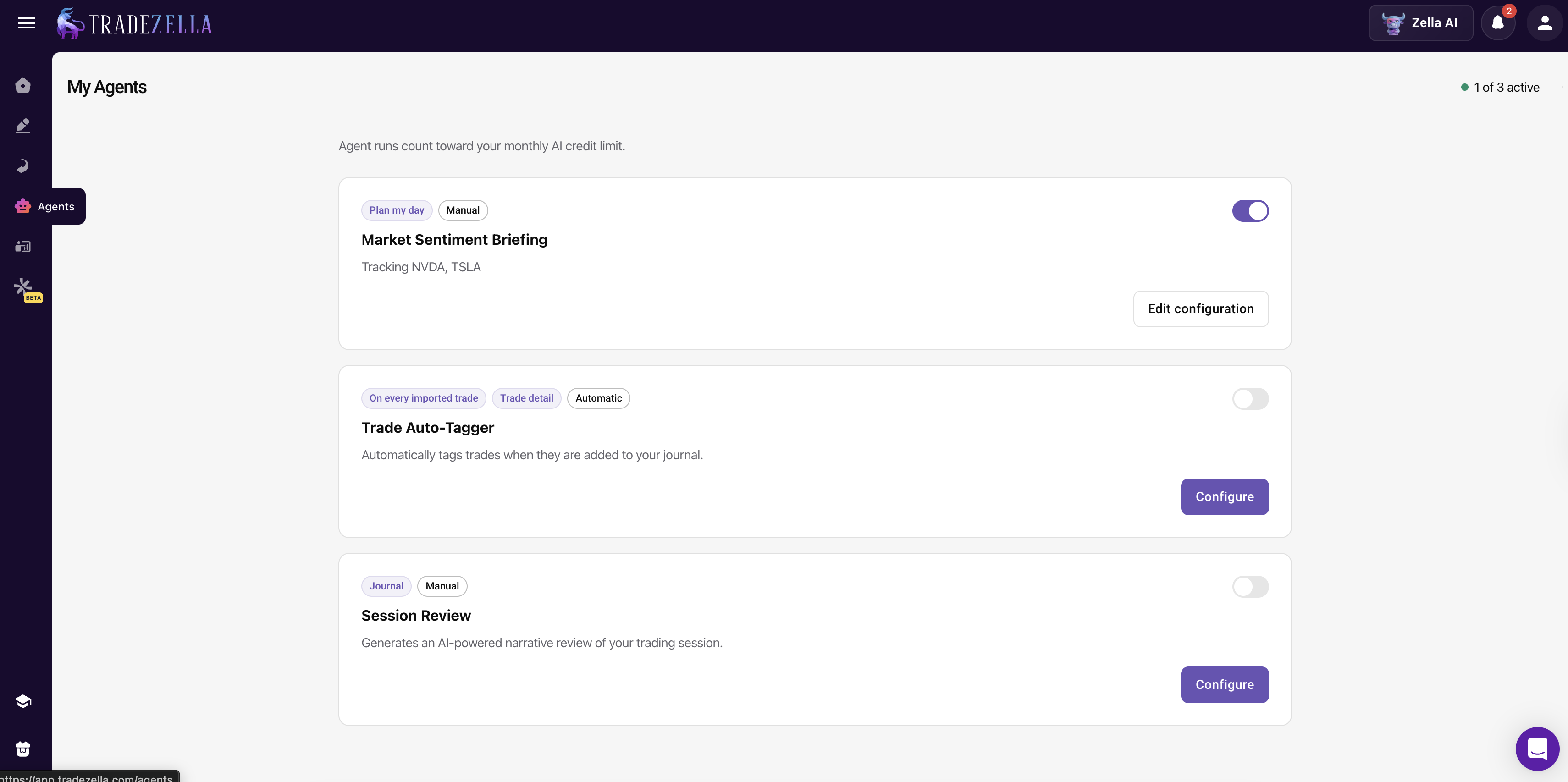
A journal with an emotional state field changes this completely. When you log "frustrated, 7/10" before a trade and then see that trades taken above frustration level 5 lose money 73% of the time, the pattern becomes impossible to ignore. Edgewonk's Tiltmeter ($197/year) is specifically designed for this, assigning tilt scores to each trade and showing the correlation between emotional state and performance. TradeZella's Session Review agent goes a step further, automatically flagging revenge trades and sizing deviations after every session so emotional patterns never slip past you.
3. No Trade Review Process
A trader who takes 30 to 50 trades per week without reviewing any of them is practicing the same way a basketball player practices by shooting without tracking makes and misses. The volume creates the illusion of progress while the same errors repeat endlessly.
The difference between screen time and deliberate practice is review. Taking trades teaches you nothing if you never go back to study what worked. Weekly journal reviews are where the actual learning happens. You scroll through your last 20 trades, mark the ones that followed your plan versus the ones that deviated, and calculate metrics for each category.
This takes 20 to 30 minutes on a Sunday evening. Those 30 minutes produce insights that 40 hours of live trading never will, because live trading happens too fast for genuine self-assessment. With Zella AI's Session Review agent, much of this work happens automatically — it journals your day, highlights rule breaks, and delivers a structured recap without you lifting a finger.
4. Position Sizing Errors
Position sizing mistakes destroy more accounts than bad entries. A trader who risks 5% on a "high conviction" trade, 0.5% on the next, and 8% on a revenge trade has no risk management system. They have a gambling habit with varying bet sizes.
A 10% drawdown requires an 11.1% gain to recover. A 25% drawdown requires 33.3%. A 50% drawdown requires 100%. Position sizing errors compound because each loss makes the next recovery harder. A journal that tracks actual risk per trade exposes these patterns before they become fatal.
A journal tracks your actual risk in dollars and as a percentage of your account. When you review and see that you risked 6% on three consecutive trades last Tuesday (right after two losses), the connection between emotional state and position sizing becomes obvious. You can set rules: "Never risk more than 2% per trade. After two consecutive losses, reduce to 1% for the rest of the session." Zella AI's Auto Trade Tagger tracks sizing consistency across every trade, making it easy to spot when your risk discipline breaks down.
5. Strategy Drift
Strategy drift is the slow, unconscious abandonment of your trading plan. It starts small. You take one trade that does not quite meet your criteria because "it looked good." That trade wins, so next time you bend the rules further. Within a month, your actual trading looks nothing like the strategy you backtested.
A journal with tagged setups solves this completely. When every trade is tagged as "A+ setup," "B setup," or "off-plan," you can filter results by category. If your A+ setups win at 65% with a 2.5:1 reward ratio and your off-plan trades win at 41% with a 0.8:1 ratio, the cost of drift is quantifiable. TradeZella offers 25+ strategy templates and custom tagging specifically for this purpose. Its Market Sentiment Briefing agent delivers a personalized pre-session report each morning, keeping you aligned with your strategies instead of chasing random setups.
What the Research Shows
Psychologist K. Anders Ericsson found that elite performers in every field share one trait: they do not just practice; they practice with structured feedback, self-assessment, and targeted correction. In trading, the journal is the mechanism that turns screen time into deliberate practice.
Prop firms have understood this for decades. Firms like SMB Capital, T3 Trading, and Maverick Trading require daily journals from every trader. This is not optional. It is considered as fundamental as the trading itself. The reason: traders who review their performance improve. Traders who do not, repeat.
A prop firm managing millions in trader capital does not require journaling because it is a nice idea. They require it because their data shows it works. Internal metrics from trading education platforms suggest traders who journal for at least 90 days see measurable improvements in win rates and a reduction in average loss size.
Before and After: A Real Scenario
Consider a trader named Marcus. He trades small-cap momentum stocks with a $30,000 account, averaging 8 to 12 trades per day.
Months 1 through 3: No Journal
- Month 1: Down $1,100. Blames "choppy markets" and moves on.
- Month 2: Down $1,800. Taking more trades but does not connect this to frustration.
- Month 3: Down $1,300. Total loss: $4,200 (14% of account). No idea which trades were good or bad.
Marcus is doing what 80% of losing traders do: trading with volume but without analysis.
Months 4 through 6: With a Journal
Marcus starts logging every trade with setup type, emotional state (1 to 10), planned risk vs actual risk, and whether the trade followed his rules. After 3 weeks, his journal reveals three patterns:
- Afternoon trades are bleeding money. Win rate before 11:30 AM: 58%. After 1:00 PM: 34%.
- He averages 3.2 revenge trades per week, all within 10 minutes of a loss, with a 78% loss rate.
- His "B setup" trades lose 61% of the time, while A+ setups win at 64%.
He makes three changes: stop trading after noon, implement a 15-minute cooling period after any loss, and only take A+ setups.
- Month 4: Down $200 (adjusting to fewer trades).
- Month 5: Up $850. Fewer trades, higher win rate, smaller losses.
- Month 6: Up $1,150. Net over 3 months: +$1,800.
The strategy did not change. The entries did not change. What changed was that Marcus could see his own behavior in data, and the data made the right adjustments obvious.
How to Start Today
Option 1: Free spreadsheet. Download our free trading journal template. It tracks date, ticker, setup type, entry, exit, P&L, risk percentage, emotional state, and notes. This is enough to build the habit and start collecting data.
Option 2: Dedicated software. If you want auto-import, built-in analytics, and advanced tagging, an AI trading journal does the heavy lifting for you:
- TradeZella ($29/mo) supports 500+ brokers, 50+ analytics reports, Zella AI (ask any question about your trading data and get personalized answers, plus 3 autonomous agents that tag trades, deliver pre-session briefings, and generate post-session reviews), trade replay in 3 modes, and 25+ strategy templates. The leading AI trading journal for serious traders. Ranked #1 in our 2026 review.
- TraderSync ($29.95/mo) supports 950+ brokers with Cypher AI coaching. The widest broker coverage available.
- Edgewonk ($197/year) offers 200+ importers, the Tiltmeter for emotional tracking, and Edge Finder AI. Best value for psychology-focused traders.
Option 3: Pen and paper. If you take a handful of trades per day, a notebook works. Write what you traded, why, how you felt, and what you would do differently. Review weekly.
The gap between losing traders and profitable traders is not intelligence or talent. It is the willingness to track, review, and learn from every trade. A journal is the simplest, most proven tool for crossing that gap. The 70 to 90% failure rate is the default. Your journal is how you opt out of it.
Frequently Asked Questions
Is a trading journal worth the time investment?
A daily review takes 15 to 30 minutes. A weekly review takes 30 to 45 minutes. If that time prevents even one revenge trade per week on a $25,000 account (3% risk = $750), the return on investment is massive. The traders who say journaling takes too much time are usually the ones who need it most.
Can journaling help specifically with revenge trading?
Yes, and revenge trading is one of the patterns most responsive to journaling. The key is logging your emotional state before each trade on a 1-to-10 scale. After 30 to 50 trades, you will see a clear correlation between elevated frustration levels and losing trades. The most effective intervention is a time-based rule: after any loss, wait 15 minutes before your next trade and write one sentence about how you feel. This creates a circuit breaker between the emotional trigger and the impulsive action. Traders who implement this rule typically eliminate 60 to 80 percent of their revenge trades within 4 to 6 weeks.
What is the minimum viable journal entry?
At minimum, log five fields per trade: date, ticker, direction (long or short), P&L in dollars, and one sentence explaining why you entered. This takes under 30 seconds per trade. Even this bare-minimum entry, when reviewed weekly, reveals patterns like which setups you actually trade versus which you think you trade. You can add fields like emotional state, setup type, and risk percentage later once the habit is established. The most important thing is consistency. A simple journal you use every day beats a complex one you abandon after two weeks.
Does journaling work for automated or algorithmic trading?
Journaling serves a different but equally valuable purpose for algo traders. Instead of logging individual trade decisions, you journal your system development process: parameter changes, backtest results, when and why you overrode the algorithm, and your emotional state when you intervened. Many algo traders lose money not because their systems fail, but because they manually interfere during drawdowns. A journal tracking every manual override reveals whether your interventions helped or hurt overall performance.
How do successful traders structure their weekly review sessions?
Most profitable traders follow a three-part weekly review. First, metrics review (5 minutes): check win rate, average R-multiple, profit factor, and largest loss for the week. Second, pattern review (10 to 15 minutes): sort trades by setup type and emotional state, looking for which categories outperformed or underperformed. Third, rule adjustment (5 minutes): write one specific change for the coming week based on the data, such as reducing position size on a setup that has been underperforming. The entire session takes 20 to 25 minutes and should happen at a fixed time each week, typically Sunday evening.
What percentage of traders actually keep a journal?
No exact industry figure exists, but estimates from prop firms and trading educators suggest fewer than 10% of retail traders maintain a consistent journal. Among funded prop firm traders, that number is closer to 80 to 90% because firms require it. The gap between retail failure rates (70 to 90%) and prop firm success rates tracks closely with journaling discipline. The habit itself does not guarantee profitability, but the absence of it correlates strongly with failure.
How does a trading journal prevent overtrading?
A journal creates accountability by making every trade visible. When you know you have to log a trade, write the reason for entry, and review it later, the psychological cost of taking a low-quality setup increases. Many traders set a daily trade limit in their plan and use the journal to track compliance. After a few weeks, the data usually shows that trades taken after the daily limit was reached have significantly worse performance, which reinforces discipline.
Can a trading journal help with risk management?
Yes. Logging your position size, stop loss, and actual risk per trade creates a historical record of your risk behavior. Most traders discover they risk more than they think. A journal reveals patterns like increasing position size after wins (overconfidence), widening stops on losing trades (hope), or risking more during specific market conditions. Platforms like TradeZella generate risk reports automatically, showing your average risk per trade, largest drawdown, and risk-adjusted returns across different setups.
Why do traders stop journaling after a few weeks?
The two most common reasons are complexity and delayed results. Traders who build elaborate 30-column spreadsheets burn out from the data entry burden. Start with 5 to 7 fields per trade and add more only when needed. The second issue is expecting immediate results. Journaling is a compounding habit: the first 30 entries reveal little, but after 100+ trades, patterns emerge that are impossible to see without data. Traders who survive the first 8 weeks of journaling rarely stop.
Is there scientific evidence that trading journals improve performance?
Direct peer-reviewed studies on trading journals specifically are limited, but the underlying principles are well established in performance psychology. Deliberate practice research (Ericsson, 1993) shows that structured self-review is the primary differentiator between experts and amateurs across domains. In trading specifically, prop firms and hedge funds have decades of internal evidence that structured trade review improves P&L consistency, which is why journaling is mandatory at most professional firms.