

Quick Verdict
Tradervue logs your trades. TradeZella helps you understand why you won or lost and what to do differently next time. That gap shows up in the scores: 9.4/10 vs 5.2/10 in our testing, the widest margin in any comparison we cover. If you just need a free record of your trades, Tradervue works. If you want tools that actually move the needle on your P&L, TradeZella is the clear pick.
| Quick Stats | TradeZella | Tradervue |
|---|---|---|
| TJ Score | 9.4/10 | 5.2/10 |
| Trustpilot | 4.8/5 | 2.6/5 |
| Price | $24–49/mo | Free–$49.95/mo |
| Brokers | 500+ | 80+ |
| Backtesting | Yes (11+ years, all plans) | No |
| Trade Replay | Yes (3 modes, all plans) | No |
| Strategy Templates | 25+ templates | No |
| AI Features | Zella AI | No |
| Education | Zella University | No |
| Mentor Mode | Spaces (unlimited students) | Basic sharing |
| Mobile App | No | No |
| Free Plan | No | Yes (30 trades/mo) |
Bottom line: The question is whether a free trade log is enough for your goals. Tradervue records what happened. TradeZella goes further: it analyzes your performance across 50+ dimensions, lets you backtest strategies before risking real capital, and replays your actual trades so you can study your own decision-making. For casual traders who take a handful of trades per month, Tradervue's free tier does the job. For anyone serious about improvement, TradeZella is the better investment.
Overview
These two platforms answer fundamentally different questions. Tradervue asks: "Where do I log my trades?" TradeZella asks: "How do I become a better trader?" Tradervue was one of the original trading journals, built in 2011, and it still works as a straightforward trade log with community features. TradeZella is a modern performance platform where journaling is just the starting point for analysis, backtesting, and structured improvement.
The scores reflect that divide: TradeZella earns 9.4/10 to Tradervue's 5.2/10 in our testing. Trustpilot tells a similar story, 4.8/5 from 800+ reviews vs 2.6/5. In 2026, traders expect their journal to do more than record trades. They want to know why they won, where they leak money, and whether a strategy works before they risk real capital. Tradervue's development pace hasn't kept up with those expectations.
That said, Tradervue still offers something TradeZella does not: a free plan. For casual traders who take fewer than 30 trades per month, that matters. The real question is whether free logging is enough, or whether you need the deeper tools that come with a paid platform.
TradeZella at a Glance
- TJ Score: 9.4/10
- Trustpilot: 4.8/5 (800+ reviews)
- Price: $29–$49/month ($24–$33/mo billed annually)
- Broker Integrations: 500+
- Key Strength: All-in-one platform with backtesting, strategy templates, replay, and education
- Assets: Stocks, Options, Futures, Forex, Crypto
- Historical Data: 11+ years (back to September 2014)
- Strategy Templates: 25+ ready-made strategy templates
- Free Trial: No
Tradervue at a Glance
- TJ Score: 5.2/10
- Trustpilot: 2.6/5
- Price: Free (30 trades/mo), Silver $29.95/mo, Gold $49.95/mo
- Broker Integrations: 80+
- Key Strength: Free plan and community mentorship
- Assets: Stocks, Options, Futures, Forex (no crypto)
- Track Record: One of the original trading journals
- Mobile App: No
Head-to-Head Feature Comparison
| Feature | TradeZella | Tradervue |
|---|---|---|
| Automated Trade Import | ✓ (500+ brokers) | ✓ (80+ brokers) |
| Asset Classes | Stocks, Options, Futures, Forex, Crypto | Stocks, Options, Futures, Forex |
| Analytics Reports | 50+ pre-built | Basic (6–8 report types) |
| AI Features | Zella AI | No |
| Backtesting | All plans, unlimited (11+ years) | No |
| Trade Replay | All plans (3 modes) | No |
| Strategy Templates | 25+ templates + custom | No |
| ICT Indicators | Built-in (FVG, ASR, HTF Bias, etc.) | No |
| MFA/MFE Analysis | Yes | No |
| Zella Scale | Yes | No |
| Best Exit Analysis | Yes | No |
| Auto Chart Generation | Yes (with executions plotted) | Yes (TradingView integration) |
| Mentor Mode | Spaces (unlimited students) | Share trades publicly/privately |
| Education | Zella University | No |
| Community | Built-in community | Forums & trade sharing |
| Commission Tracking | Yes | Yes |
| Mobile App | No | No |
| Prop Firm Tools | Prop Firm Sync | No |
| Free Plan | No | Yes (30 trades/mo) |
| TJ Score | 9.4/10 | 5.2/10 |
| Trustpilot Rating | 4.8/5 | 2.6/5 |
Detailed Comparison
1. Pricing & Value
TradeZella Pricing:
| Plan | Monthly | Annual |
|---|---|---|
| Basic | $29/mo | $24/mo ($288/yr) |
| Premium | $49/mo | $33/mo ($399/yr) |
Tradervue Pricing:
| Plan | Price | Key Features |
|---|---|---|
| Free | $0 | 30 trades/month, basic import, community access |
| Silver | $29.95/mo | Unlimited trades, full reports, sharing |
| Gold | $49.95/mo | Auto-import, risk analysis, commissions |
Tradervue's free plan is its strongest selling point: 30 trades per month at no cost. For casual swing traders who take a handful of trades monthly, that's a legitimate option for basic trade logging.
The moment you start paying, the value equation flips. At $29/mo, TradeZella Basic gives you a complete performance improvement toolkit: deep analytics, backtesting against 11+ years of data, trade replay for reviewing your own executions, and structured strategy management. At $29.95/mo, Tradervue Silver gives you unlimited trade logging and basic reports. Same price bracket, completely different capability.
Tradervue Gold ($49.95/mo) adds auto-import and risk analysis. Those are features TradeZella includes on its $29/mo Basic plan. You end up paying nearly $50/mo for functionality that costs $29 elsewhere, without getting backtesting, replay, or AI analytics in return.
Winner: Tradervue for the free plan, no contest. TradeZella at every paid tier, where the same dollar buys meaningfully more capability.
2. Journaling & Trade Import
TradeZella connects to 500+ brokers: Interactive Brokers, MetaTrader 4/5, cTrader, TradeLocker, NinjaTrader, Tradovate, ThinkorSwim, Schwab, Robinhood, and hundreds more. Trades sync automatically. The platform supports 5 asset classes including crypto.
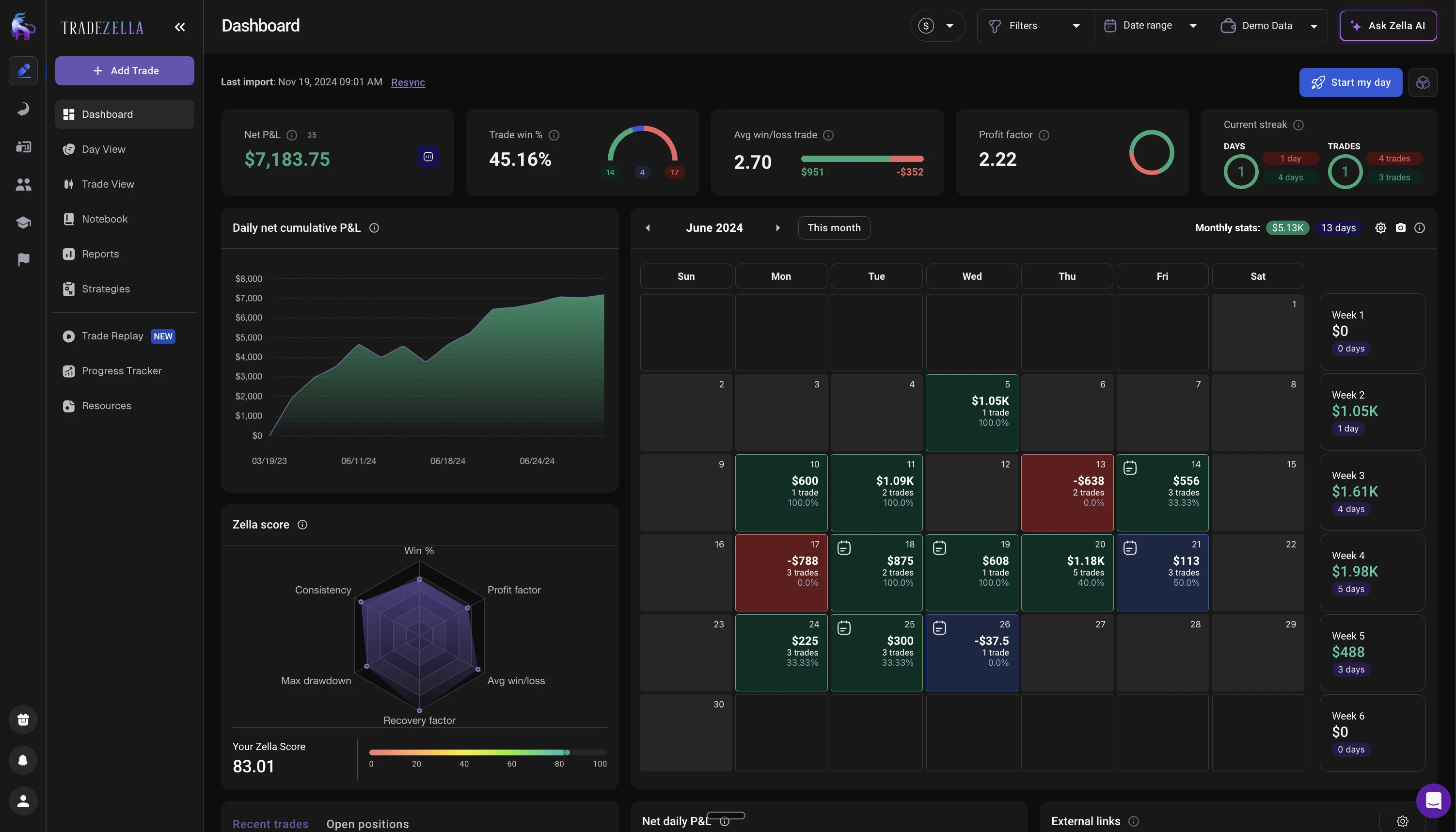
The journaling goes deep: tags and custom categories feeding into 50+ reports, an advanced global filter, a built-in notebook with templates, MFA/MFE statistics, Zella Scale, Best Exit Analysis, and risk management tools with automatic R-multiple calculation.
Tradervue connects to 80+ brokers, a much smaller network that still covers major US platforms but misses many international brokers and newer platforms. Auto-import is only available on the Gold plan ($49.95/mo); Silver users must upload CSV files manually. Tradervue supports 4 asset classes, notably excluding crypto.
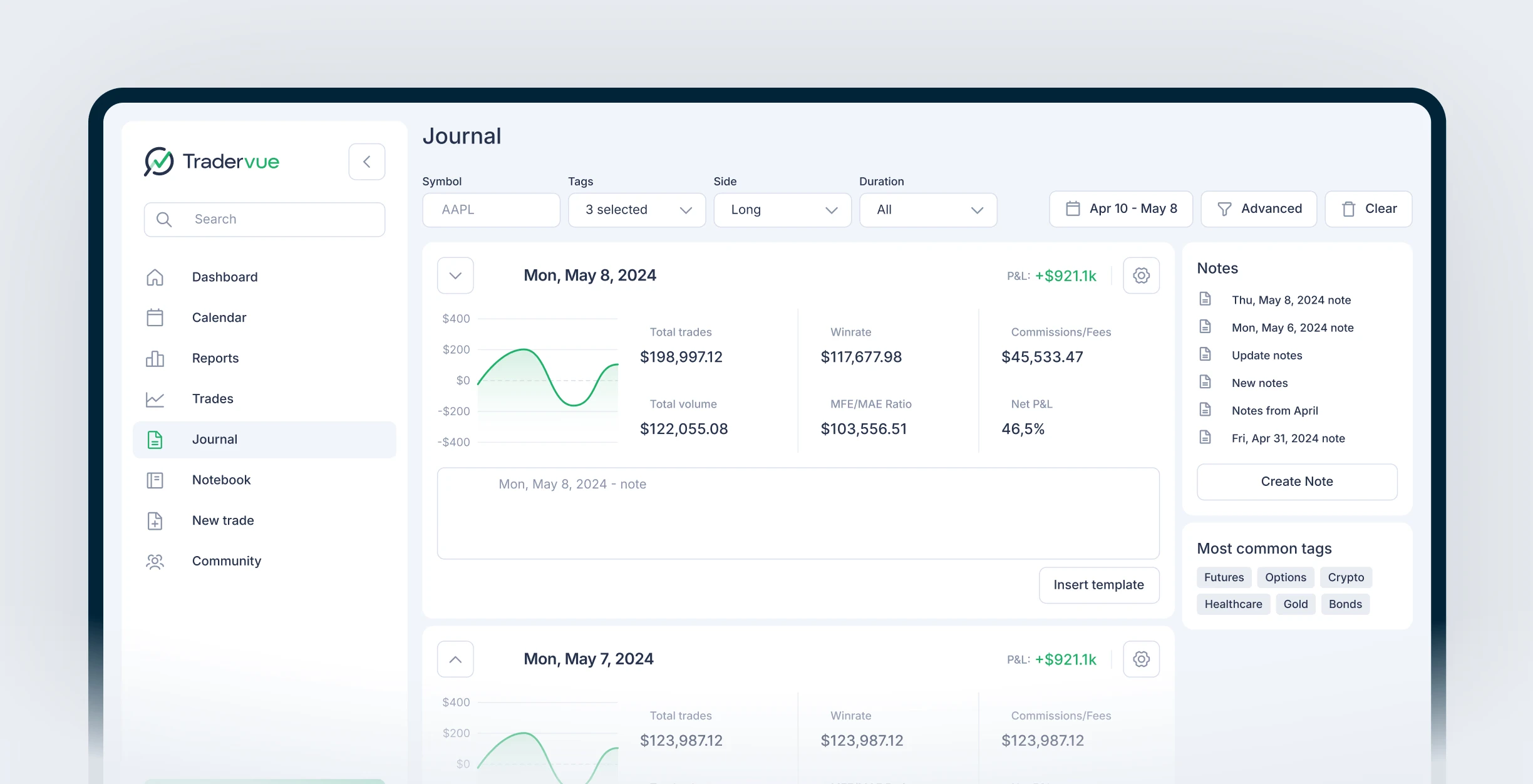
The journaling is functional but basic. You can log trades, add notes, and tag setups. TradingView integration automatically generates charts with entry/exit points plotted. Commission tracking is available on paid tiers.
The practical difference: TradeZella connects to 6x more brokers and auto-imports on every plan. With Tradervue, auto-import requires the $49.95/mo Gold tier. If your broker is not in Tradervue's smaller network, you are stuck with manual CSV uploads regardless of what you pay.
Winner: TradeZella. Broader broker coverage and deeper journaling tools that go beyond logging into actual performance analysis.
3. Analytics & Reports
TradeZella generates 50+ pre-built analytics reports: date and time analysis (day of week, time of day, session, duration), price and quantity reports (symbol, price level, position size), risk reports (R-multiple, risk-adjusted returns), wins vs. losses breakdowns, custom tag reports, and a Compare feature. Every custom tag automatically generates its own performance report.
Tradervue provides basic reports covering day of week, time of day, trade duration, instrument performance, and tag-based analysis. The reports are clear and readable but limited in scope, roughly 6–8 report types vs. TradeZella's 50+. More detailed analytics require the Silver ($29.95/mo) or Gold ($49.95/mo) tier.
This matters because pattern discovery drives improvement. Are you more profitable on Tuesdays? Does your win rate drop with larger position sizes? Do you bleed money in the last hour of trading? You can only answer those questions if your platform slices the data enough ways. Tradervue's handful of reports scratches the surface. TradeZella's 50+ reports let you interrogate your performance from every meaningful angle.
Winner: TradeZella. The depth of analysis here is what separates a trade log from a performance improvement tool.
4. AI & Smart Features
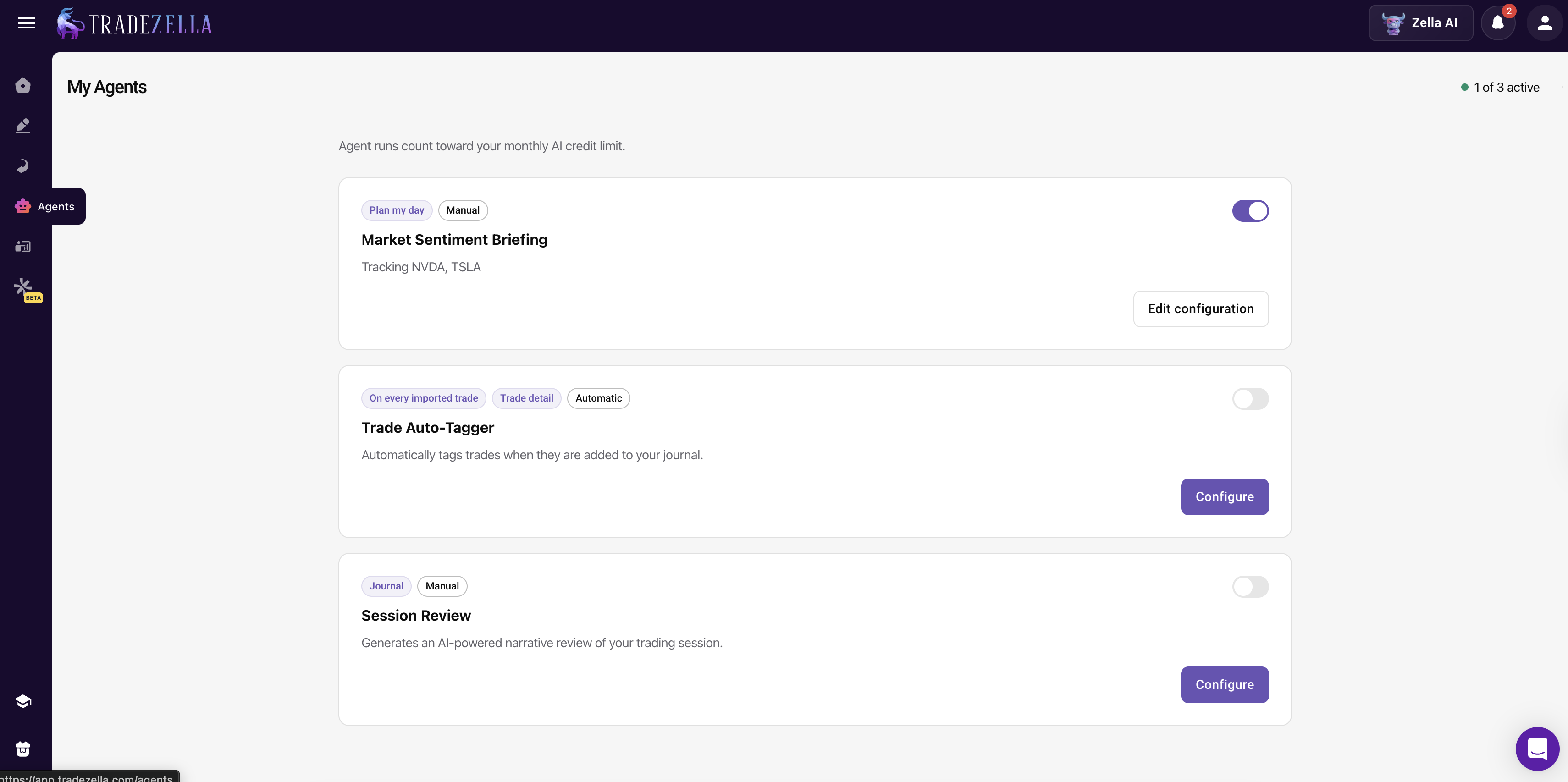
TradeZella's Zella AI is a full AI trading partner. Three autonomous agents work in the background without prompting: Session Review automatically journals your entire trading day and flags rule breaks, Auto Trade Tagger categorizes every trade based on your rules, and Market Sentiment Briefing generates a personalized pre-market plan each morning. Conversational AI lets you ask questions about your data in plain language and get instant answers. AI-powered pattern detection scans your complete trade history across 50+ reports to surface the factors driving your P&L and flag behavioral patterns. Tradervue has no AI at all.
Tradervue has no AI features. No agents, no pattern detection, no conversational AI, no automation. All interpretation is manual.
In 2026, traders increasingly expect their AI trading journal to work for them — not just store data. Zella AI's Session Review journals your day automatically. Auto Trade Tagger categorizes every trade without manual input. Market Sentiment Briefing builds your pre-market plan before you open a chart. And conversational AI answers any question about your data on demand. Tradervue requires you to do all of this by hand.
Winner: TradeZella. Zella AI is a full AI trading partner that proactively works on your behalf. Tradervue has no AI at all.
5. Trade Replay
TradeZella offers Trade Replay on all plans with two modes: Trade Replay (rewatch individual trades second by second) and Day Replay (replay your entire trading session to understand sequence and psychology), with Scenario Replay (compare similar setups for pattern recognition) coming soon. You get speed control up to 30x, entry/exit markers, multiple timeframes, Time of Sales, Level II data, and integrated journaling during replay.
Tradervue does not have trade replay. You can view static charts of your trades (generated through TradingView), but you can't step through market data as it unfolded.
Trade replay transforms how you learn from your trades. Instead of looking at a static chart and trying to remember what you were thinking, you can rewatch the market unfold in real time and identify exactly where your decisions went right or wrong. For day traders, it's one of the most effective improvement tools available.
Winner: TradeZella. Replay turns a static trade record into a learning session. Without it, you are relying on memory to figure out what went wrong.
6. Backtesting
TradeZella includes unlimited backtesting on all plans with 11+ years of historical data back to September 2014. The backtesting engine supports multi-symbol testing (up to 5 per session), multi-chart layouts (up to 8 simultaneously), built-in ICT indicators (FVG, Asian Session Range, HTF Bias, Key Levels, Power of 3), realistic execution with market/limit/stop orders, drag-and-drop SL/TP, speed control (0.5x to 10x), economic calendar on chart, Go-To feature for jumping to dates/sessions, and complete integration with strategy templates. Every backtested trade auto-logs to your journal.
Tradervue does not have backtesting.
Backtesting lets you validate a strategy against real historical data before risking real money. Without it, your only option is to test ideas live and absorb the losses. TradeZella's backtesting is thorough enough that many traders skip standalone backtesting platforms entirely. Tradervue has no equivalent, so you would need a separate tool or go straight to live testing.
Winner: TradeZella. The ability to test before you trade is one of the highest-impact features a journal can offer, and Tradervue does not have it.
7. Strategy Tools
TradeZella provides 25+ ready-made strategy templates from professional traders, covering ICT-based approaches, volume profile, break and retest, auction market theory, and more. You can create custom strategy templates with specific rules, tag trades to strategy templates, track each strategy template's performance, log missed trades (setups you didn't take), and share strategy templates with others.
Tradervue has no strategy management system. You can tag trades by setup type, but there's no framework for documenting strategies, tracking strategy template performance, or accessing professional templates.
The practical value: you can take a proven strategy template, trade it for a month, and see exactly how it performed in your hands. Over time, you build a clear picture of which approaches suit your style and which ones lose money. In Tradervue, you can tag trades, but there is no framework for tracking strategy-level performance or learning from professional setups.
Winner: TradeZella. Strategy templates turn abstract "trading plans" into measurable, improvable systems.
8. Community & Mentorship
Both platforms emphasize community, but in different ways.
TradeZella:
- Spaces (Mentor Mode): Full mentorship platform where mentors can monitor up to 5 students simultaneously with color-coded P&L, access students' full dashboards (Trade Log, Notebook, Strategy Templates, Reports), leave targeted feedback on specific trades, create organized coaching folders, and manage unlimited students with no per-seat fees
- Built-in community features
- Shared strategy templates for collaborative learning
Tradervue:
- Trade sharing: Publish trades to the community or share privately with specific people
- Mentor access: Give a mentor read access to your journal
- Community forums: Browse and comment on other traders' shared trades
- Message boards: Topic-based discussions
Tradervue's community was pioneering in 2011 and still functions as a place for traders to share and discuss trades. The mentor-sharing feature works, though it's basic, mentors can view your trades but don't have the analytics, feedback tools, or structured coaching interface that TradeZella's Spaces provides.
TradeZella's Spaces is a professional mentorship platform. The color-coded P&L monitoring, full account access, targeted trade feedback, and unlimited student capacity make it a tool designed for serious coaching relationships, not just sharing trades.
Winner: TradeZella. Spaces turns mentorship into a real workflow where coaches can review data, leave feedback on trades, and track student progress. Tradervue's open community is worth noting, though, especially for self-directed learners who want to browse how other traders approach the market.
9. Education & Learning
TradeZella includes Zella University: webinars, app tutorials, lessons on recovering from trading losses, and content covering journaling best practices, risk management, and trading psychology. All included in every paid plan at no extra cost.
Tradervue has no education platform. No courses, no webinars, no structured learning content.
For traders who want to improve their skills alongside tracking trades, Zella University adds meaningful value, especially for intermediate traders working to develop consistency.
Winner: TradeZella. Zella University means you do not need to piece together free YouTube tutorials to learn risk management or trading psychology. The content is built into the platform you are already using.
10. User Experience & Interface
TradeZella features a modern, clean interface designed for the current generation of web applications. Navigation between journaling, analytics, backtesting, and education feels intuitive. The customizable dashboard lets you arrange widgets to match your workflow. The overall experience reflects a platform built with modern design standards.
Tradervue was designed in 2011 and looks it. The interface is functional but dated, reminiscent of web applications from a previous era. For users who prioritize aesthetics and modern UX, Tradervue's interface can feel like a step backward. The 2.6/5 Trustpilot rating partly reflects user frustration with the platform's pace of updates and modernization.
That said, Tradervue's simplicity can be an advantage for traders who want straightforward trade logging without complexity. If you just need to import trades and look at basic stats, the no-frills interface gets the job done.
Winner: TradeZella. A cleaner interface matters more than it sounds. When you journal daily, friction in the UX compounds. A modern, intuitive layout means you are more likely to actually use the tool consistently.
Annual Cost Comparison
| Scenario | TradeZella | Tradervue |
|---|---|---|
| Free tier | Not available | Free (30 trades/mo) |
| Entry paid plan | $288/yr (Basic annual) | $359.40/yr (Silver) |
| Full-featured plan | $399/yr (Premium annual) | $599.40/yr (Gold) |
| Features at paid tiers | 50+ reports, backtesting, replay, strategy templates, education, mentor tools, AI | Basic reports, unlimited trades, auto-import (Gold only) |
Look at what happens when you commit to a year. TradeZella Basic ($288/yr) costs less than Tradervue Silver ($359.40/yr) while delivering analytics, backtesting, and replay that Tradervue does not offer at any price. TradeZella Premium ($399/yr) costs 33% less than Tradervue Gold ($599.40/yr) and still includes capabilities Tradervue cannot match.
If your budget is zero, Tradervue wins. The moment you decide to invest in your trading, the math favors TradeZella: lower annual cost, higher capability ceiling.
Choose TradeZella If You...
- Want to understand why you win and lose, not just log that it happened
- Need to test strategies against historical data before risking real money
- Want to replay your trades and study your own decision-making
- Are working with a mentor or coaching students
- Trade crypto, or need broad broker coverage (500+)
- Are preparing for prop firm evaluations
Choose Tradervue If You...
- Need a free trading journal with basic logging
- Take fewer than 30 trades per month
- Want to browse a community of other traders' shared trades
- Prefer the simplest possible trade logging without complexity
- Are on an extremely tight budget and don't need advanced features
- Want to share trades openly with a public community
- Only trade stocks, options, futures, or forex (not crypto)
Final Verdict
This comparison comes down to one question: is a free trade log enough?
If your goal is simply to record what you traded, Tradervue's free plan does that. It has done that since 2011, and it still works. For casual traders taking fewer than 30 trades per month who just need a basic record, there is no reason to pay for something else.
But logging trades, by itself, does not make you a better trader. Improvement comes from understanding the patterns behind your results: which setups work, which sessions cost you money, whether a strategy holds up across hundreds of historical trades. That requires analytics, backtesting, and replay. Those tools cost money because they take serious engineering to build, and Tradervue does not offer them at any price.
After testing both platforms, TradeZella (9.4/10) is the stronger choice for traders who want their AI trading journal to be an active part of their improvement process, not just a passive record. The 4.2-point scoring gap and the Trustpilot divide (4.8/5 vs 2.6/5) reflect a real difference in what these platforms deliver. Read our full TradeZella review for the detailed breakdown.
Tradervue deserves credit as a pioneer that helped define the trading journal category. The free plan remains genuinely useful. But for anyone who has moved past "I need to log my trades" and arrived at "I need to figure out why I keep losing on Fridays," TradeZella is the tool built for that job.
Visit TradeZella → Visit Tradervue →
Frequently Asked Questions
Is Tradervue still worth using in 2026?
The free plan is still worth it for casual traders who need basic trade logging at no cost. At paid tiers ($29.95–$49.95/mo), Tradervue is difficult to recommend when TradeZella offers dramatically more features at the same or lower prices.
Does Tradervue support crypto?
No. Tradervue supports stocks, options, futures, and forex. If you trade crypto, TradeZella is among the platforms that support it with 500+ broker integrations.
Is TradeZella worth the cost vs. free Tradervue?
If you trade actively and want to improve, yes. TradeZella's backtesting, trade replay, 50+ reports, strategy templates, and education tools provide value that basic trade logging can't match. If you only need a free record of your trades, Tradervue's free tier is fine.
Does Tradervue have AI features?
No. Tradervue has no AI-powered analysis, no pattern recognition, and no automated insights. TradeZella offers 50+ analytics reports and Zella AI, which provides conversational analysis plus three AI agents that handle session reviews, trade tagging, and pre-market planning without manual effort.
Why does Tradervue have a low Trustpilot rating?
Tradervue's 2.6/5 Trustpilot rating reflects user concerns about slow development, a dated interface, and a feature set that hasn't kept pace with modern competitors. The platform still functions for basic trade logging but has fallen behind in analytics, AI, and advanced features.
Does either platform have a mobile app?
Neither has a native mobile app. TradeZella offers a responsive web experience accessible from mobile browsers. Tradervue is desktop-focused with limited mobile functionality.
Can I backtest strategies with Tradervue?
No. Tradervue does not have a backtesting feature. TradeZella offers full backtesting with 11+ years of historical data, multi-chart layouts, and built-in ICT indicators. If strategy testing is important to your trading process, Tradervue cannot accommodate it.
Does Tradervue have trade replay?
No. Tradervue does not offer trade replay. TradeZella provides two replay modes: Trade Replay (rewatch individual executions) and Day Replay (replay your full trading day). For traders who learn by reviewing their executions visually, this is a major gap in Tradervue's feature set.
What does Tradervue offer that TradeZella does not?
Two things: a free plan (30 trades/month) and a built-in community with public trade sharing. Tradervue lets you publish trades for peer feedback, which is valuable for traders who learn through community interaction. TradeZella has no free tier and no public community feed, though its Spaces feature provides private mentor/student connections.
How many brokers does Tradervue support vs TradeZella?
TradeZella supports 500+ brokers with auto-sync. Tradervue supports approximately 80+ brokers. Both cover major brokers like Interactive Brokers, TD Ameritrade, and E*TRADE, but TradeZella has significantly broader coverage for specialized and international brokers.