
Quick Verdict
After testing both platforms across 8 categories, TradeZella (9.4/10) is the better AI trading journal for most traders in 2026. Its philosophy is structured trader development: give you the tools, templates, and education to systematically improve. TraderSync (7.8/10) takes a different path, leaning on interactive AI coaching and a polished mobile experience to guide you trade by trade. Both are premium products, but TradeZella delivers more at every price point.
| Quick Stats | TradeZella | TraderSync |
|---|---|---|
| TJ Score | 9.4/10 | 7.8/10 |
| Trustpilot | 4.8/5 | 4.7/5 |
| Price | $24–49/mo | $16–40/mo (annual) |
| Brokers | 500+ | 950+ |
| Backtesting | Yes (11+ years, ICT indicators) | Yes (systematic, 70+ indicators) |
| Trade Replay | Yes (3 modes) | Yes (up to 250ms) |
| Strategy Templates | 25+ templates | No |
| AI Features | Zella AI | Cypher AI |
| Education | Zella University + Spaces | Limited |
| Mobile App | No | iOS & Android |
| Free Trial | No | 7 days |
Bottom line: These two journals represent different philosophies. TradeZella is built around structured growth: it gives you a framework for developing as a trader through proven templates, deep backtesting, and built-in education. TraderSync is built around responsive coaching: its AI talks to you in real time, and its mobile apps let you review anywhere. For most traders, TradeZella's structured approach produces better long-term results at a lower ceiling price. TraderSync is the pick if mobile access or conversational AI coaching is your top priority.
Overview
TradeZella and TraderSync are the two highest-rated trading journals on the market, with TJ Scores of 9.4/10 and 7.8/10 and strong Trustpilot ratings of 4.8/5 and 4.7/5. Both automate trade tracking, provide AI-powered analysis, and cover stocks, options, futures, forex, and crypto.
The difference is philosophical. TradeZella treats trading improvement as a structured discipline. It provides the curriculum (Zella University), the playbook (25+ strategy templates from professional traders), and the practice field (backtesting with 11+ years of data). The idea: give traders a systematic framework and let them build skill over time. TraderSync treats trading improvement as an ongoing conversation. Cypher AI coaches you interactively, the mobile apps keep you connected between sessions, and the 950+ broker integrations ensure the platform fits into whatever setup you already use.
Neither approach is wrong. But one delivers meaningfully more for your money. This comparison breaks down every category so you can judge for yourself.
TradeZella at a Glance
- TJ Score: 9.4/10
- Trustpilot: 4.8/5 (800+ reviews)
- Price: $29–$49/month ($24–$33/mo billed annually)
- Broker Integrations: 500+
- Key Strength: All-in-one platform with backtesting, strategy templates, and education
- Assets: Stocks, Options, Futures, Forex, Crypto
- Historical Data: 11+ years (back to September 2014)
- Strategy Templates: 25+ ready-made strategies
TraderSync at a Glance
- TJ Score: 7.8/10
- Trustpilot: 4.7/5
- Price: $29.95–$79.95/month (~$16–$40/mo billed annually)
- Broker Integrations: 950+
- Key Strength: AI coaching (Cypher AI) and precision market replay
- Assets: Stocks, Options, Futures, Forex, Crypto
- Free Trial: 7 days
Head-to-Head Feature Comparison
| Feature | TradeZella | TraderSync |
|---|---|---|
| Automated Trade Import | ✓ | ✓ |
| Broker Integrations | 500+ | 950+ |
| Asset Classes | Stocks, Options, Futures, Forex, Crypto | Stocks, Options, Futures, Forex, Crypto |
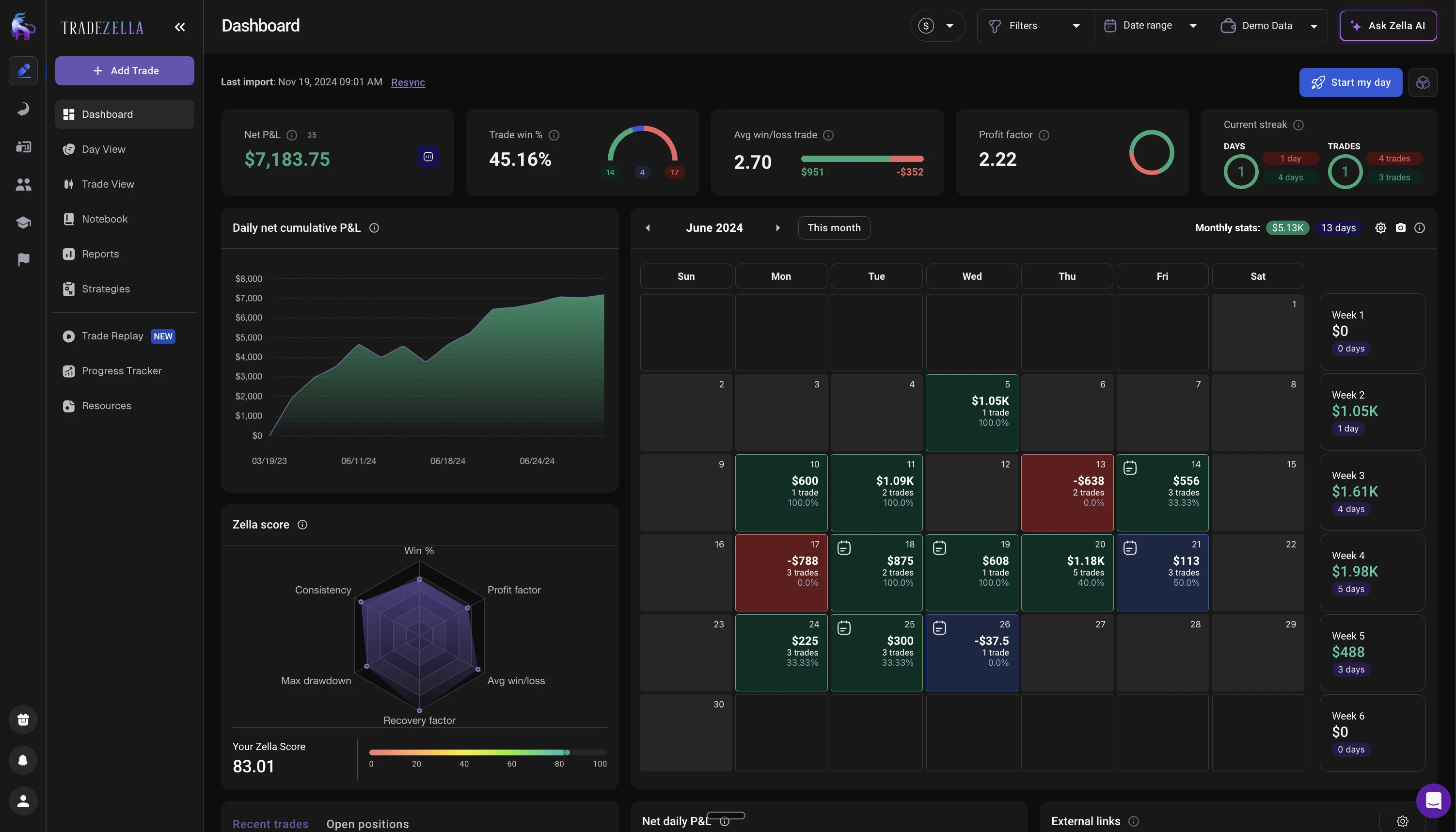
| Analytics Reports | 50+ pre-built | 20+ customizable widgets |
| AI Features | Zella AI | Cypher AI (interactive) |
| Trade Replay | All plans (3 modes) | All tiers (3 precision levels) |
| Backtesting | All plans, unlimited (11+ years) | Systematic (70+ indicators, 30K+ assets) |
| Strategy Templates | 25+ templates + custom | No |
| Strategy Checker | Yes (rule-based strategies) | Yes (rule compliance) |
| ICT Indicators | Built-in (FVG, ASR, HTF Bias, etc.) | No |
| Multi-Chart Backtesting | Up to 8 charts, 5 symbols | No |
| MFA/MFE Analysis | Yes | Limited |
| Zella Scale | Yes | No |
| Best Exit Analysis | Yes | No |
| Mentor Mode | Spaces (unlimited students) | No |
| Education | Zella University (webinars, app tutorials) | Limited |
| Mobile App | No | iOS & Android |
| Prop Firm Tools | Prop Firm Sync | No |
| Free Trial | No | 7 days |
| TJ Score | 9.4/10 | 7.8/10 |
| Trustpilot Rating | 4.8/5 | 4.7/5 |
Detailed Comparison
1. Pricing & Value
TradeZella Pricing:
| Plan | Monthly | Annual |
|---|---|---|
| Basic | $29/mo | $24/mo ($288/yr) |
| Premium | $49/mo | $33/mo ($399/yr) |
TraderSync Pricing:
| Plan | Monthly | Annual (with discount) |
|---|---|---|
| Pro | $29.95/mo | ~$16/mo (~$197/yr) |
| Premium | $49.95/mo | ~$25/mo (~$300/yr) |
| Elite | $79.95/mo | ~$40/mo (~$480/yr) |
TraderSync's annual discounts (up to 50% off) make the entry-level pricing look attractive. But pricing only matters relative to what you actually get.
At $29/mo, TradeZella's Basic plan already reflects the platform's structured development philosophy: you get the full analytics suite (50+ reports), all replay modes, unlimited backtesting with 11+ years of data, strategy templates, and Zella University. The idea is that every subscriber, regardless of tier, gets the complete learning framework from day one.
TraderSync's entry point ($29.95/mo Pro) reflects its coaching-first approach: you get Cypher AI from the start, which is a genuine advantage for traders who want immediate interactive guidance. But replay is limited to 1-minute precision at this tier, and the deeper coaching capabilities unlock as you move up.
The pricing philosophies diverge further at scale. TradeZella maxes out at $49/mo for Premium, which unlocks everything the platform offers. TraderSync's top tier (Elite at $79.95/mo) is 63% more expensive and is the only way to access 250ms replay with Level II data. Traders who need TraderSync's best capabilities end up paying significantly more per year for a narrower feature set.
Winner: TradeZella. For most traders, the question is simple: do you want a platform that front-loads its best tools at every tier, or one that gates its premium capabilities behind a higher ceiling? TradeZella's approach means you spend less and get more, regardless of which plan you choose.
2. Journaling & Trade Import
Both platforms excel at automated trade importing. Connect your broker, and trades appear automatically with full execution details, timestamps, and P&L.
TradeZella advantages:
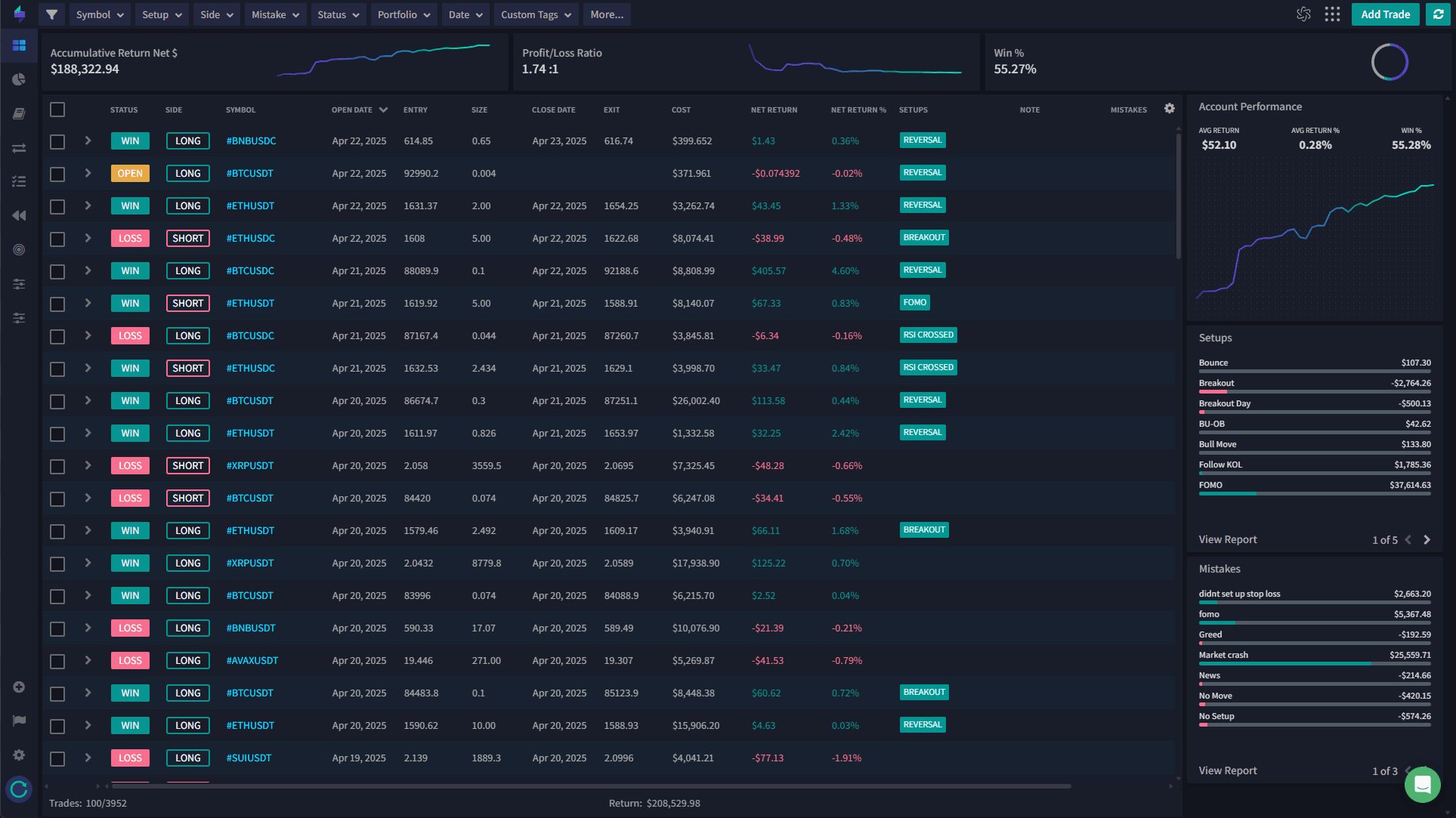
- Tags and custom categories that feed directly into your 50+ reports
- Advanced Global Filter that slices data by any criteria across all analytics
- Built-in notebook with templates for trading plans, watchlists, and daily recaps
- Risk management tools with automatic R-multiple calculation
- MFA/MFE statistics showing maximum favorable and adverse excursion per trade
- Zella Scale measuring your actual vs. potential profit/loss
- Best Exit Analysis showing what P&L would have been with different exit strategies
TraderSync advantages:
- 950+ broker integrations, the widest coverage in the industry
- Mobile app for on-the-go trade logging and note-taking
- Near-instant syncing across devices
For 95%+ of retail traders, 500+ broker integrations covers every major platform: Interactive Brokers, MetaTrader 4/5, cTrader, TradeLocker, NinjaTrader, Tradovate, ThinkorSwim, Schwab, Robinhood, and hundreds more. TraderSync's edge in broker count matters mainly for traders using niche regional brokers.
Where TradeZella pulls ahead is in the depth of journaling: MFA/MFE, Zella Scale, Best Exit Analysis, and the way tags flow directly into analytics. These aren't surface features; they fundamentally change what you can learn from your trade logs.
Winner: Tie. This comes down to what "journaling" means to you. If it means getting trades into the system from as many brokers as possible with mobile access, TraderSync has the edge. If it means extracting deeper insight from every trade through advanced metrics like MFA/MFE, Zella Scale, and Best Exit Analysis, TradeZella has the edge. Most traders need both, so we call this even.
3. Analytics & Reports
This is one of TradeZella's strongest differentiators.
TradeZella generates over 50 pre-built analytics reports covering every angle of trading performance: date and time analysis (day of week, time of day, session, duration), price and quantity reports (symbol, price level, position size), risk reports (R-multiple, risk-adjusted returns), wins vs. losses breakdowns, and custom tag reports. Every tag you create automatically generates its own performance report. The Compare feature lets you pit any two sets of trades against each other, morning vs. afternoon, trending vs. ranging, or any other split.
TraderSync offers 20+ customizable dashboard widgets with interactive charts, equity curves, drawdown analysis, win/loss ratios, profit factor, Sharpe ratio, and timing analysis. The widgets are drag-and-drop configurable, which gives power users significant control over their dashboard layout.
TraderSync's dashboard is strong, but it's a customizable widget view rather than a structured reporting suite. TradeZella's 50+ pre-built reports offer a more systematic, comprehensive way to interrogate your data. Having 50+ ways to slice your performance means you can discover patterns, like your win rate by day of week crossed with position size, that would require manual calculation in other platforms.
Winner: TradeZella. If your goal is to find the hidden patterns in your trading (which setups work on which days, how position size affects your win rate, whether your afternoon trades drag down your morning edge), TradeZella's structured reporting suite makes that kind of discovery routine rather than manual. TraderSync's customizable dashboard is flexible, but it puts the burden of analysis on you.
4. AI Features: Zella AI vs Cypher AI
Both platforms have invested heavily in AI, but their approaches serve different purposes.
TradeZella's Zella AI combines autonomous agents with conversational AI. Three agents work in the background without prompting: Session Review analyzes your entire trading day and journals it automatically, Auto Trade Tagger categorizes every trade based on rules you define, and Market Sentiment Briefing generates a personalized pre-market plan each morning. On top of that, conversational AI lets you ask questions about your data in plain language — "what's my win rate on breakouts before 10 AM?" — and get instant, data-grounded answers. Zella AI's pattern detection adds another layer, scanning your complete trading history to surface the specific factors driving your P&L, flag risk concentration, and identify behavioral patterns you might miss. The analysis is integrated directly into your reports and dashboard, so the insights sit alongside the data that supports them.
TraderSync's Cypher AI takes a coaching-first approach. It's conversational and interactive: you can ask it questions, get real-time guidance, and receive strategy adjustment suggestions as you trade. Cypher learns your patterns over time and becomes more accurate after 50 to 100+ logged trades. It flags setups aligned with your historical edge and calls out behavioral blind spots like revenge trading or overconfidence. It's available from the Pro tier ($29.95/mo).
Cypher AI is a solid conversational coaching tool, but Zella AI operates on a different level. While Cypher waits for you to ask questions, Zella AI's three agents work autonomously in the background — Session Review journals your day and flags rule breaks, Auto Trade Tagger categorizes every trade, and Market Sentiment Briefing builds your pre-market plan. On top of that, Zella AI's conversational AI lets you ask anything about your data, just like Cypher. So TradeZella matches Cypher's conversational coaching and adds proactive automation that TraderSync doesn't have.
Zella AI functions as a true AI trading partner: it does the work before you ask, and answers when you do. Cypher AI is reactive — it responds when prompted but doesn't take initiative. For traders who want AI that actively works on their behalf, Zella AI is the clear leader.
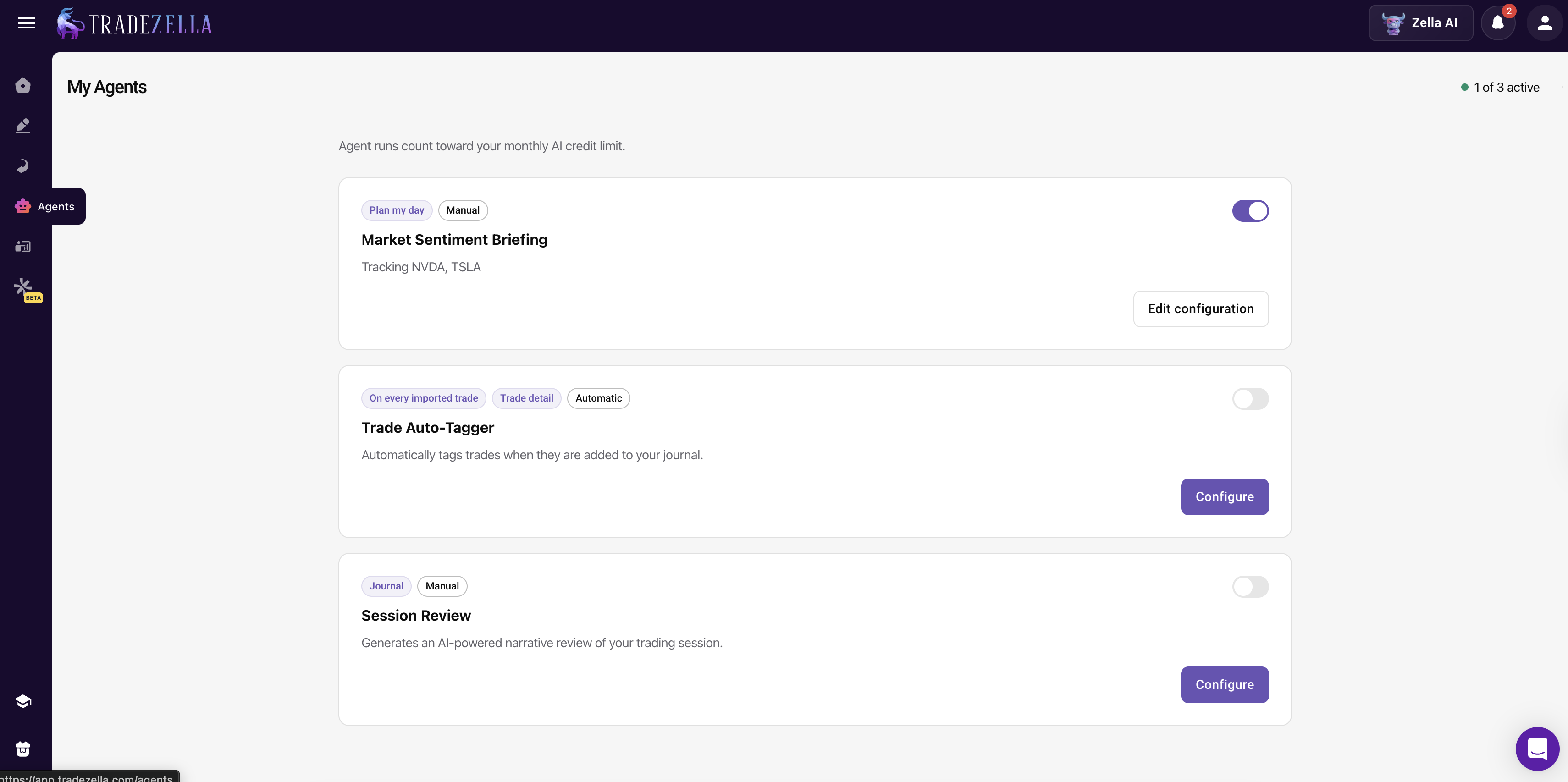
Winner: TradeZella. Zella AI does everything Cypher AI does — conversational questions, pattern detection, behavioral coaching — and adds three autonomous agents that work proactively without prompting. Cypher AI is a strong conversational tool, but it only works when you ask. Zella AI is a full AI trading partner that works on your behalf around the clock.
5. Trade Replay
Both platforms offer trade replay, but implementations differ.
TradeZella Trade Replay:
- Available on all plans (Basic and Premium)
- Two replay modes: Trade Replay (individual trades) and Day Replay (entire sessions), with Scenario Replay (compare similar setups for pattern recognition) coming soon
- Second-by-second playback with customizable intervals
- Speed control: 1x, 2x, 10x, 20x, or 30x
- Entry/exit markers plotted on charts
- Multiple timeframe views
- Time of Sales data and Level II market depth during replay
- Integrated journaling, tag mistakes, add notes, capture screenshots during replay
- Jump to any execution point instantly
TraderSync Market Replay:
- Available on all paid tiers
- Three precision levels: 1-minute bars (Pro), 1-second bars (Premium), 250-millisecond bars + Level II data (Elite)
- Dedicated Market Replay feature
- Interactive practice and trade review
TraderSync's precision tiers are a genuine competitive advantage. The 250ms Elite replay with Level II order book data is unmatched for scalpers analyzing execution quality or practicing ultra-short-term strategies. The progression from 1-minute to 1-second to 250ms gives traders a clear upgrade path as they need more granularity.
TradeZella's replay takes a different approach, offering three distinct modes (Trade, Day, and Scenario) rather than three precision levels. The Day Replay mode, which lets you rewatch your entire trading session, is particularly valuable for understanding how your first loss affected your second entry or comparing early vs. late session behavior. The integrated journaling during replay (tagging, notes, screenshots that sync to reports) is also a feature TraderSync doesn't match.
Both include Level II data in their offerings, and both are available on all plans, an important point since some competitors restrict replay to premium tiers.
Winner: TraderSync. If you're a scalper or high-frequency day trader who needs to study executions at the millisecond level, TraderSync's 250ms Elite replay is the best in the industry and worth the premium. For swing traders or position traders who care more about reviewing full sessions and tagging mistakes during replay, TradeZella's multi-mode approach is arguably more practical. But on raw replay precision, TraderSync wins.
6. Backtesting
This is where the platforms diverge significantly.
TradeZella Backtesting:
- Unlimited sessions on all plans (Basic and Premium)
- 11+ years of historical data going back to September 2014
- Multi-symbol support (up to 5 per session)
- Multi-chart layouts (up to 8 charts simultaneously)
- Multiple timeframes down to the second
- Built-in ICT indicators: Fair Value Gap (FVG), Asian Session Range, HTF Bias, Key Levels, Power of 3
- Realistic execution: market, limit, and stop orders with automatic position sizing by risk percentage
- TP/SL by price, USD, or percentage with auto-breakeven
- Drag-and-drop SL/TP on chart
- Manual partials (25%, 50%, 75%, or custom)
- Speed control: 0.5x, 1x, 2x, 5x, 10x
- Economic calendar integrated on chart
- Go-To feature to skip to specific dates or sessions
- RTH/ETH data for stocks and futures
- Every backtested trade auto-logged to journal with full details
- Direct integration with strategy templates
TraderSync Backtesting:
- Systematic, rule-based testing
- 70+ technical indicators and 100+ candlestick patterns
- 30,000+ assets to test against
- Define entry/exit conditions using price-based rules
- Performance metrics for simulated results
Both platforms offer backtesting, which not every journal does. But the approaches differ substantially.
TradeZella's backtesting is closer to a professional-grade charting and simulation environment. The 11+ years of historical data, multi-chart layouts (up to 8 simultaneously), multi-symbol sessions (up to 5), and built-in ICT indicators create a complete strategy development workspace. The integration with strategy templates is particularly powerful, you can backtest a strategy, log the results to your journal, and track that template's performance alongside your live trades, all within one platform.
TraderSync's backtesting is more systematic and indicator-driven, better for traders who want to define rule-based strategies using technical indicators and test them against a wide universe of assets. The 30,000+ asset coverage is impressive for scanning.
For discretionary traders (the majority of retail traders), TradeZella's visual, chart-based backtesting with ICT indicators and strategy template integration is more practical. For systematic traders building indicator-based strategies, TraderSync's approach may feel more natural.
Winner: TradeZella. This is where the structured development philosophy pays off most clearly. Backtesting, strategy templates, and journaling are all connected in TradeZella: you test a strategy, the results flow into your journal, and you can track that strategy's performance over months alongside your live trades. TraderSync's systematic backtesting is solid for rule-based indicator strategies, but it operates more as a standalone feature than part of an integrated development workflow.
7. Strategy Tools
TradeZella offers a complete strategy management system through its strategy templates feature. You get 25+ ready-made strategy templates created by professional traders, including strategies from traders like Umar Ashraf, Anthony Crudele, and Alex Temiz. Templates cover ICT-based approaches, volume profile, break and retest, auction market theory, and more. Each template includes the full framework: overview, rules, entry/exit criteria, and example trades.
Beyond templates, you can create your own strategies with defined rules, tag trades to specific templates, track each template's performance over time, and even log missed trades (setups that fit your strategy but you didn't take, revealing whether fear or distraction is costing you).
TraderSync offers the Strategy Checker, a rule compliance tool that tracks whether you follow your own trading rules (position size limits, max daily loss, profit target compliance, trade timing). It shows your compliance percentage over time and identifies which rules you break most frequently.
These tools serve different purposes. TradeZella's strategy templates are about building, testing, and tracking strategies. TraderSync's Strategy Checker is about maintaining discipline with existing rules. Both are valuable, but TradeZella's approach is more comprehensive. It covers strategy creation, testing, documentation, performance tracking, and shared learning.
Winner: TradeZella. The difference here reflects the broader platform philosophies. TradeZella helps you build and develop strategies (creation, testing, tracking, sharing). TraderSync helps you stick to strategies you've already defined (rule compliance, discipline tracking). Both matter, but most traders struggling to improve need the former before the latter. You need a strategy before you can enforce discipline around it.
8. Mobile Experience
TradeZella: No native mobile app. The web platform is responsive and works on mobile browsers, but it's not the same as a dedicated app.
TraderSync: Full-featured iOS and Android apps with near-complete desktop parity. Trade logging, AI coaching, analytics, Market Replay. All available from your phone. The mobile experience is genuinely polished.
For traders who review performance during commutes, log trades on the go, or manage positions throughout the day from their phone, TraderSync's mobile apps are a decisive advantage.
Winner: TraderSync. If mobile access is a requirement for your workflow (reviewing trades on the commute, logging notes between sessions, checking analytics away from your desk), this single category could be decisive. TradeZella's responsive web interface works on phones, but it's not the same as a dedicated native app.
9. Broker Support
TradeZella: 500+ broker integrations covering all major retail platforms: Interactive Brokers, MetaTrader 4/5, cTrader, TradeLocker, NinjaTrader, Tradovate, ThinkorSwim, Schwab, Robinhood, and hundreds more.
TraderSync: 950+ broker integrations, the most extensive network in the trading journal category. Every major platform plus many regional and niche brokers.
Both cover virtually every broker that retail traders in the US, Europe, and major markets use. The 500-integration gap matters primarily for traders using less common or international brokers. If you trade with a regional broker in Southeast Asia or Eastern Europe, TraderSync is more likely to have a native integration.
For the vast majority of traders, both platforms cover every broker they'd realistically use.
Winner: TraderSync. The practical impact depends on your broker. If you trade through any major platform (Interactive Brokers, MetaTrader, ThinkorSwim, NinjaTrader, Tradovate, Robinhood, Schwab), both journals have you covered. The 450-integration gap matters mainly for traders on regional or niche brokers, but TraderSync's broader coverage is a real advantage in those cases.
10. Education & Mentorship
TradeZella:
- Zella University: Webinars, app tutorials, lessons on recovering from trading losses, and content covering journaling best practices, risk management, and trading psychology
- Spaces (Mentor Mode): Full mentorship platform with unlimited student capacity. Mentors can monitor up to 5 students simultaneously with color-coded P&L, access students' full dashboards (Trade Log, Notebook, Strategies, Reports), leave targeted feedback on specific trades, and create organized coaching folders. Students maintain privacy controls and can revoke access anytime
- Community features built into the platform
TraderSync:
- Cypher AI provides coaching-like guidance through conversational interaction
- Limited educational content beyond AI coaching
- No structured learning curriculum
- No dedicated mentor tools
TradeZella's investment in education and mentorship is a significant differentiator. Zella University provides structured learning content at no additional cost. Spaces gives mentors and coaches professional-grade tools for managing students, not just a shared login, but a proper mentorship dashboard with analytics, feedback tools, and privacy controls.
TraderSync's Cypher AI provides valuable coaching-like interaction, but it's AI coaching, not a platform for human-to-human mentorship. For traders working with a coach, in a trading group, or enrolled in a mentorship program, TradeZella's Spaces feature is genuinely unique.
Winner: TradeZella. This category highlights the core philosophy difference most clearly. TradeZella treats education as inseparable from journaling: the university content teaches you, the strategy templates give you frameworks to practice, and Spaces connects you with mentors who can see your actual data. TraderSync's Cypher AI provides coaching-like interaction, but it's AI guidance, not a platform for structured human mentorship. If you're serious about learning (not just tracking), TradeZella's approach is meaningfully more complete.
Annual Cost Comparison
| What You Get | TradeZella | TraderSync |
|---|---|---|
| Entry-level plan | $288/yr (Basic) | ~$197/yr (Pro, annual) |
| Full-featured plan | $399/yr (Premium) | ~$300/yr (Premium, annual) |
| Maximum tier | $399/yr (Premium) | ~$480/yr (Elite, annual) |
TraderSync's entry-level annual pricing (~$197/yr) is cheaper on paper. But the practical question is: what are you paying for? At that tier, TraderSync gives you AI coaching and basic replay. TradeZella's Basic ($288/yr) gives you the full structured development toolkit from day one.
The gap widens at the top. TradeZella's maximum annual cost is $399 for Premium, which unlocks every feature the platform offers. TraderSync's equivalent (Elite at ~$480/yr) costs $81 more per year and is the only way to access 250ms replay and full API access. You pay more for less breadth.
Put differently: a trader who wants the best of everything from TradeZella pays $399/yr. A trader who wants the best of everything from TraderSync pays $480/yr. The TradeZella subscriber ends up with deeper backtesting, strategy templates, and integrated education. The TraderSync subscriber ends up with faster replay and mobile apps. That's the tradeoff.
Which Philosophy Fits You?
Choose TradeZella if you believe trading improvement comes from structure. You want a platform that gives you proven frameworks (strategy templates), deep historical data to test against (11+ years of backtesting), objective analytics to study (50+ reports), and educational resources to fill knowledge gaps (Zella University). You work with or plan to work with a mentor. You do most of your analysis at a desk. And you want one platform that handles the entire development cycle rather than stitching together separate tools.
Choose TraderSync if you believe trading improvement comes from responsive, ongoing feedback. You want an AI coach (Cypher AI) that talks to you about your trades in real time. You review your performance on the go and need polished mobile apps. You're a scalper who needs 250ms replay precision. Or you use a less common broker and need the widest possible integration network (950+). You also value being able to try before you buy (7-day free trial).
Final Verdict
TradeZella is the better AI trading journal for most traders in 2026.
This comparison tested two genuinely different philosophies. TradeZella bets that traders improve fastest when they have a structured system: strategy templates from professionals, deep backtesting to validate ideas, comprehensive analytics to identify patterns, and education built into the platform. TraderSync bets that traders improve fastest with responsive coaching: an AI that learns your habits, mobile access for anytime review, and precision replay for studying executions.
Both philosophies have merit, and both platforms are excellent (Trustpilot ratings of 4.8 and 4.7 confirm that real users agree). But in our testing, TradeZella's structured approach wins more categories and delivers more value per dollar. Its maximum tier costs $49/mo. TraderSync's costs $79.95/mo. And TradeZella's $49 tier includes tools (backtesting, templates, university, Spaces) that TraderSync simply does not offer at any price.
TraderSync remains the right call for traders who need mobile apps, 250ms replay precision, or conversational AI coaching today. Those are real advantages for the right user. But for the majority of traders looking for one platform to invest in for long-term development, TradeZella gives you more for less.
With Prop Firm Sync Mode and Zella AI (conversational AI plus three autonomous agents) now live, plus Scenario Replay coming soon, TradeZella's lead has widened further in 2026.
Visit TradeZella → Visit TraderSync →
Frequently Asked Questions
Does TradeZella have a mobile app?
No. TradeZella does not have a mobile app. The web platform is responsive on mobile browsers but doesn't match a native app. TraderSync's iOS and Android apps are a clear advantage.
Is TraderSync worth $80 a month?
The Elite tier ($79.95/mo, ~$40/mo annually) is justified only for professional scalpers or options traders who need 250ms replay precision with Level II data. Most traders find the Premium tier ($49.95/mo) sufficient. At $80/mo, it's significantly more expensive than any other trading journal on the market.
Which is better for options trading?
Both support options but take different approaches. TradeZella supports simple options (buying and selling calls and puts) with 50+ analytics reports and custom tags for tracking strategies. TraderSync has a dedicated options trading journal and an Options Market Replay Simulator. Neither platform confirms multi-leg strategy support.
Can I use TradeZella for prop firm trading?
Yes. TradeZella connects to all major prop firm platforms and has a Prop Firm Sync Mode that lets you connect prop firm accounts, manage multiple evaluations, and track payouts all from one dashboard.
TradeZella vs TraderSync for beginners?
TradeZella is generally better for beginners. The interface is more intuitive, Zella University provides structured learning, the 25+ strategy templates give you proven frameworks to start with, and the pricing is more straightforward (two tiers vs. three). TraderSync's broader feature set can be overwhelming for new traders.
Does TradeZella offer a free trial?
No. TraderSync offers a 7-day free trial. This is one area where TraderSync has a clear advantage for traders who want to test before committing.
Which is better for futures trading?
Both support futures well. TradeZella edges ahead with RTH/ETH data in backtesting, built-in ICT indicators, and deeper historical data (11+ years). TraderSync has wider broker coverage for specialized futures platforms.
Does TraderSync have backtesting like TradeZella?
TraderSync offers a systematic backtesting feature, but it is more limited than TradeZella's. TradeZella provides a full backtesting engine with 11+ years of historical data, multi-chart layouts, ICT indicators, and integration with your strategy templates. TraderSync's backtesting focuses on replaying and analyzing past trades rather than testing new strategies against historical data.
Which platform has better AI analytics?
Different approaches. TradeZella's Zella AI powers 50+ structured analytics reports that surface patterns across your trades automatically. TraderSync's Cypher AI is conversational, letting you ask questions about your trading data in natural language. TradeZella's AI is broader and more analytical; TraderSync's AI is more interactive and coaching-oriented.
Can I use TradeZella and TraderSync with the same broker?
Yes. Both platforms connect to your broker independently, so you can run them simultaneously if needed. However, paying for two journals is expensive and usually unnecessary. Most traders choose one platform based on what they value most: TradeZella for comprehensive analytics and backtesting, or TraderSync for mobile access and AI coaching.